Generation Sex – John Hartley Williams’ Pistol Sonnets

St Peter's Basilica
St Peter’s Basilica (Photo credit: Sarah Price Photography)

Training to be a priest in Rome, St Peter’s Basilica inspired awe and reverence. It wasn’t just because the dome soars to the heavens, shot through with shafts of golden light. No. A visit to the excavations below the Basilica, where I walked the streets of the Roman necropolis just beyond the site of Nero’s circus, was enough to make any faithful Catholic stop and think about the veracity of the claim that this church is built, both physically and spiritually, upon the bones of the martyred Peter.

Calla Lily
Calla Lily (Photo credit: chiaraogan)

However, I was never quite able to look at the place in the same way after viewing the eight faces of the plinths on which Bernini’s great baldacchino rests. At first glance, each is carved with a relief of a woman’s head and a whole lot of scrollwork. However, viewed in sequence, you’ll see a woman’s face contorted in the agonies of childbirth and the scrollwork below… Well, that contorts and enlarges too – until a baby’s head pops out. There, as tourists gawp at the great baldacchino, and at the Altar of the Chair of St Peter, the Renaissance asserts its riotous secular carnality. Blink and you’ve missed it.

Italiano: Ercole Farnese (Museo Archeologico N...
The Farnese Hercules (Museo Archeologico Nazionale di Napoli) (Photo credit: Wikipedia)

For many, the sonnet is love poetry, often presenting love as inexpressible, spiritual and immortal. In Pistol Sonnets, John Hartley Williams delivers something more carnal. In Naples, the reader is transported to the Museo Archeologico Nazionale, but not in the rapt tones of the TV art evangelist. Although we have eyes, we fail to see the ‘Boys whiter than Venus / Girls with thighs like Zeus / The museum is bedroom / In which marble has fun’. Composed as a series of simple statements, this gender bending glam rock hedonism ought to be obvious to even the most simple-minded.  Yet, to the tourists, ‘Its cool and boring in here / The tourists look sick with innocence’. ‘Cool’ and ‘boring’ have a range of connotations: to the uninitiated, the marble might look cold, lifeless and dull, but cool also suggests stylish, classy sexual attractiveness. Suddenly ‘boring’ feels more virile than dull. As Williams moves into the sestet, a cruel line of dialogue satirizes the tourists’ tepid terms of endearment and itinerary-driven lack of spontaneity: ‘O look, dear, this is the Farnese Hercules’. Jupiter replies with contempt as an X-rated Ozymandias: ‘Yes, and I’m Jupiter / I’m the filthpot of the planets. Watch me / Sex a nymph’s stone crotch with my tongue’.

Stubble
Stubble (Photo credit: far closer)

This sets the tone for much of Pistol Sonnets: a warm-blooded and often unsettling experience in which desire and sex keep the world spinning. The Bastille, whose Sadean title evokes male dominated sexual violence, presents women as sacrificial, as martyrs at an auto-da-fé: ‘Between your legs is a field of razed stubble / They have set light to you, burning you off / The smoke of your scarred skin fills my nostrils’. Again, Williams plays with uncertainty as ‘razed’ evokes images of destruction and mutilation, as well as shaving. Either way, the woman’s body has been appropriated to satisfy desire. However, at the volta the tables turn and, like Aristophanes’ Lysistrata, she is able to use desire as a weapon. ‘What excites me / Is the drawn sword of your satisfaction / Your implacable withholding of basic supplies / The curved block of your sex / The falling blade of your sighs’.

English: Shakespeare's sonnet 1
Shakespeare, Sonnet I (Photo credit: Wikipedia)

Williams attacks the sensibilities of his gentle reader at every turn, mocking bardolatry in the same terms as his attack on gallery crawlers. In Guest List, the guests are dull and predictable: ‘Bankers with crocodile handkerchiefs / Teachers holding bitten-into apples / Neighbours for noodle salad / Cyclists with one clip too many / Then, of course, the lovers in bandages / And those truth-soured Judases, the poets // The ear-splitting obviousness of the latter / What makes them think we’ve not heard it before / Spouting rhymes as they corner the Queen of Occasion / Savouring each morsel of thee, thou, thine…’

It’s hard to disagree with Williams’ sentiments. Poetry was dark, sexy and dangerous way back when, so why shouldn’t it be now? This is a world-weary, noir collection of sonnets in which there is no easy correlation between desire and relationships. If Robert Browning were around today, then he might have been writing sonnets like these.

Buy Pistol Sonnets from Salt Publishing

RELATED ARTICLES

The Real Thing – Booksellers, not retail sales assistants

Norrington Room
Norrington Room, Blackwell’s, Oxford (Photo credit: TonZ)

Today’s Guardian reports that Amazon Marketplace is hiking its fees up for third-party traders. In a piece published in the same paper this time last year, Tim Waterstone vented some serious spleen, charging Amazon with ‘build[ing their] brand on a reputation for absolutely rock-bottom pricing’ and that customers ‘Go and browse through all the books there, in Waterstones […] then put them back on the tables (fingered and soiled) and order those [they] want from [Amazon]. Why pay more? Why worry about the consequences?’

What about the incomparable experience of buying from an actual bookshop? Hell, my two-year old loves our local branch of Waterstones so much that we’ve had a couple of the staff over for tea. Looking for some crime fiction for your mum when you never touch the stuff yourself? Why not try asking a human being? In a bookshop. Then there’s the serious stuff. I’ll never forget ordering a copy of Ezra Pound’s Guide to Kulchur from Blackwell’s in Oxford and watching, slack-jawed as the sales assistant typed K-U-L-C-H-U-R unprompted into his database. Now, my teenage self had regarded this as a pretty exotic request and I left the bookshop humbled and impressed. These staff aren’t just retail sales assistants, they’re booksellers. There’s a difference. I still shop at the Oxford branch of Blackwell’s and their poetry section is like no other. Pamphlets by the likes of Nine Arches Press rub shoulders with Carcanet and Faber. If you’re seeking some inspiration, a new direction, then this is a one stop shop.

Then there’s the online experience. Publishers like HappenStance, Penned in the Margins and Salt would rather sell directly. If you take them up on their offer, you’ll find your books at your doorstep just as quickly as Amazon would have managed to deliver them (if not more so). Besides this, you’ll rest easy in the knowledge that your sale has actually helped to sustain a publishing industry that you value.

These publishers, and the many like them, represent the new face of publishing. They write blogs and seek to engage with their readers through the social media. This is tremendously important, as a community of readers isn’t necessarily found on Goodreads. The kind words and encouragement from indie publishers has been important to me when writing this blog.

A high street without the likes of Waterstones would be the poorer for it. I know a two-year old who regards the bookshop as the highlight of a trip into town, and I hope that bookshops last long enough for her to be able to remember them.

Strange Boat – AF Harrold’s The Point of Inconvenience

Bluebell
Bluebell (Photo credit: TimWebb)

On passing through Warminster on our routine pilgrimage to my granny’s house, I hoped for red lights and a short queue. For there, floating improbably by a pavement in the centre of town, was a pocket battleship, a corvette, or some such. Topiary’s never really grabbed me but, for a boy whose head was full of Commando comics, gardening never looked so cool. The ship’s curves and turrets had been rendered in privet and bouncing from the smokestacks were a few untamed sprigs. No lifeless architectural topiary here then, but rather the drama of a ship’s telegraph ringing full steam ahead. One day, as our car slowed, the ship was fuzzy and out of focus, largely reclaimed by the unruly and irrepressible surge of nature. The next time I looked, it had gone. I shivered as we passed death’s shadow.

Ghost ship
Ghost ship (Photo credit: anguila40)

The Point of Inconvenience, A. F. Harrold’s collection of epistolic poems, is addressed to his late mother. In his first poem, If There Is A Beginning, Harrold searches for his first awareness of death which, like everything, must be experienced personally. My seventeen year old self shivered when reading Seamus Heaney’s The Early Purges, where the poet tells us that, ‘I was six when I first saw kittens drown’. However, the ignorance of city life does us no favours, and Harrold’s first flirtations with death were, like mine, largely experienced through pop culture’s lies: ‘It began with the death of Ben Kinobe – / though that turned out to be a cheat, a glowing ghostlife […] It began with Frodo and Bilbo taking the ship into the West, / but more it began with Sam, left to watch them go, // left to turn around and go back home and just get on / with life’. Harrold’s short line is reserved for Sam’s life without Frodo, rather than for Frodo’s departure and the reader is invited to think again about death, as Sam finds himself the wrong side of the stanza break and far from his friends. Harrold unsettles us to great effect elsewhere in the collection and never lets go of his insight that death and dying are as much about the renegotiation of relationships as they are about physical processes. In Two Texts, the etymology of ‘patient’ is explored: ‘I open the dictionary when I get home, / to answer the question you’d earlier asked – // Why must the patient be so patient? / You’d rung your bell: an unanswered sound. // The word’s from French, go far enough Greek: / from pathos, to suffer.‘ Yet, a few poems later, in Hospice Song, the speaker asks, ‘You know there came a time I hated you? / When all my patient waiting seemed in vain?’

Hospital sign
Hospital sign (Photo credit: BowBelle51)

Harrold’s observational skills are acute and although Larkin’s presence is felt (Ambulances is explicitly referenced in All Streets In Time), Harrold’s view of institutionalised care is even-handed. For example, in To The Consultant, he asks ‘how long ago did you set out / hand-wringing down antiseptic corridors, / through doors that swung as easily shut / as open, through doors that only let / those called by name inside …’ So, for Harrold, hospitals are both the alpha and the omega, whereas in Larkin’s The Building, the scale of the institution turns it into a cemetery. ‘All know they are going to die. / Not yet, perhaps not here, but in the end, / And somewhere like this’. In Aubade, Larkin ends by observing that ‘The sky is white as clay, with no sun. / Work has to be done. / Postmen like doctors go from house to house’. Yet, in Doing The Sum, as he does the sum while ‘birds / peck seed from their feeder / and the postman whistles // somewhere nearby / on his slow way to me’, Harrold’s observational, journalistic style invites the reader to see postmen as postmen. However, this is impossible after Aubade, and engaging with this poem allows Harrold to have his cake and eat it: his poetry is bare yet, at the same time, symbolically rich.

Stratford Ferry
Stratford Ferry (Photo credit: johnmuk)

The Point of Inconvenience is divided into two parts: the first runs to 53 poems, while Part II, the single poem Get Over It, is only four pages long and with this structural device Harrold reminds us of his first poem, If There Is A Beginning. It’s the living who are left with an offensive pile of worthless euphemisms and an unpalatable, unswallowable truth. It’s the living who feel trapped on the wrong side of the river. The poem mounts a sustained assault on the bankrupt metaphorical language of the everyday and, as Harrold finally abandons the poem’s couplet stanzas and rhetorical backbone, he rejects language’s capacity to articulate grief.

The Point of Inconvenience sees Harrold writing at full throttle. Some of these poems, read within the working day, stopped me dead in my tracks and have haunted me since.  He flinches at very little, confessing to feelings of selfishness and disgust which few would have the courage to air when faced with the cultural taboos surrounding death. Yet, at the same time, there’s humour here too – and a certain mundane, domestic honesty which makes AF Harrold utterly memorable. And finally, thinking about that private battleship steaming along the highway, it seems fitting to close with AF Harrold’s Summer Neglect:

Summer Neglect

Things go on growing in your garden,
but order decays. Borders grow old
and ragged, grow green. Thorny arms
reach out for ledges, for hands to hold.

Colour fades as leafy things spring up.
The human patterns grow rare. Thinking
gives way to nature. The pond evaporates,
a damp ring-mark on stones, daily sinking.

Reproduced with kind permission

RELATED ARTICLES


The child is grown, the dream is gone – Hugo Williams’ West End Final

stubber
Stubber (Photo credit: jackmalvern)

Twice a day, I studied the cigarette stubber riveted to the melamine back of the bus seat. Ash threw the lattice filigree into relief. Discarded cans were lulled by diesel acceleration. Although the top deck was frowsy with children and dulled by winter, through the headphones of my Walkman, the effortless bend of David Gilmour’s guitar created a world of shimmering purity. That is, until Comfortably Numb’s furious outro withered like heated cellophane as the cassette eviscerated itself. Today, listening to the track in lossless fidelity, Gilmour’s guitar still unravels like jammed magnetic tape.

slow dance
Slow dance (Photo credit: Homies In Heaven)

In Reckless Records, Williams’ speaker rediscovers the vinyl of his youth. ‘I wonder if this is my own copy / of A Swingin’ Affair! / which I took to a party in 1961 / and never saw again. / I was dancing with Belinda Davey, / the first one to speak to me / in that warm cheek language / of swaying on the spot / to ‘I won’t Dance’, / or ‘Nice work if you can get it’.’ The enjambed lines create an atmosphere of reverie and free association as one thought leads to another. Before too long, even the memory of unheard music has allowed Williams’ speaker to experience the ghost of physical sensation as the ‘warm cheek language’ is recalled. However, in this deceptively simple poem, Belinda Davey is an infatuation and not an enduring passion and the stanza break suggests that the estrangement suffered is from the intimately known music of our youth. ‘I lost touch with Frank, for a few decades after that’, Williams writes, as nostalgia gets the better of us all in the end and we make the mistake of returning, only to discover, like Shakespeare’s Duke Orsino, that the music ‘is not so sweet as it was before‘.

facebook like button
Facebook like button (Photo credit: Sean MacEntee)

The trick with nostalgic urges is to recognize that they are as pernicious and habit-forming as full-blown vices and should be resisted. In The Cull, from a sequence entitled Poems to My Mother, Williams’ keenly observed poem demonstrates the power of the pen, as ‘You sit with your address book / open on your knee, / gently but firmly / crossing out the names / of old friends who have died. / ‘I wonder what happened / to Kay Morrow?’ you ask. / ‘It doesn’t matter, / I never liked her really.’ / Your pen hovers briefly / over the head of the bridesmaid / we’ve heard so much about, / then slices her in two’. Like all cleaning, the Godlike mother starts with the clearly defined task of erasing the dead from the book of life but cleaning has a habit of going wrong: before you know it, the kitchen’s taxonomy requires redesigning before another rotting vegetable can be removed from the fridge, and soon the living also find themselves slipping away. The bridesmaid is not even granted a name, so far has her stock fallen over the years and the clinical stroke of the ‘cull’ reminds us that this is a necessary decimation of the ranks of addresses for the good health of those left. Curiously, this poem feels as relevant to the age of Facebook and Twitter as to the age of snail mail. Today, people worry about the possibility that the friend will observe their absence from the roll of honour and that they will take offence at the slight. So, we read tweets and status updates begging the fair weather friends to unfriend themselves in a bizarre form of suicide.

Reflections in a dark glass
Reflections in a dark glass (Photo credit: Neil. Moralee)

West End Final begins by presenting a series of childhood vignettes and, amidst the domesticity, Gothic horror emerges. Williams’ eye is acute and his disarming economy concentrates the power of his words. The title, Ghost Train, for example, invites the reader to imagine the lurid dumb show of the end of the pier. What Williams’ terse lines and two quatrains presents us with shakes our preconceptions, as ‘We disappeared into tunnels, sucking sweets’. The sweets invite us to read this as a Just William moment but the word ‘disappeared’ hints at the horror of a permanent darkness. The second quatrain becomes a parallel train, reflected in the dark glass: ‘How long ago and far away we look, / sitting together there without moving / in the dark train / that is travelling beside our own’. The collection offers a few moments like these and Elsie Byers, in which an unlucky doll is buried in the garden, reads like an understated horror movie.

School punishment book page
School punishment book page (Photo credit: theirhistory)

The childhood Williams presents is a dark one. A Suitable Cane, which begins with a child being sent to choose and buy the instrument with which they will be beaten, reminded me of Paul Muldoon’s Anseo. As the casual brutality of Muldoon’s school system creates Joseph Mary Plunkett Ward, the future IRA commander who has been ordered to cut for himself the ‘stick with which he would be beaten’, so Williams’ 1950s are tainted with a sickening connoisseurship, as Ollivander’s wand shop is crossed with the Marquis de Sade. ‘At Thomas’s I ask to see a selection / and the old gentleman takes down / various items for my approval: / the knobbly ‘School’ cane, / the curve-handled ‘Pop’ cane, / the straight but bendy ‘House’ cane. / I can’t make up my mind.’ The hushed gentility of a gentlemen’s outfitters is in dark, hilarious opposition with the debauched violence of the school Library, ‘a book-free zone, plastered with nude pin-ups / of French and Italian starlets’. Then, with a good sense of comic timing, Williams presents the reader with the next poem, ‘Slapstick’, where the speaker is ‘Grim-all-day’.

The Ballad of Sexual Dependency (1986). The im...
Nan Goldin, The Ballad of Sexual Dependency (1986). The image on the cover is “Nan and Brian in Bed” (1981). (Photo credit: Wikipedia)

At the heart of Williams’ collection is A Pillow Book, a sequence whose title nods to Sei Shōnagon‘s tenth century collection of poems and court gossip. As the twelve numbered lyrics move full circle around the clock face, they convey a sense of inevitability and cyclic futility: the heat of passion becomes a memory. In number 12, the lover is finally eroded, remembered as a set of actions and not as herself at all. ‘Is that you over there / in your nightdress, / standing on one leg, / looking at the sole of your foot? // It must be you / because all your things are still here – / face creams and cotton buds, / cleanser and eyeliner, // scattered across the table / where you put on make-up / and do your hair’. In number 1, the lover told us that ‘I lie in bed, watching you / dress yourself in nudity’ and this passion, this deflated expectation haunts the room like the child eating sweets in the dark train in the tunnel. The lover must now be covered. Nudity was a costume donned for a performance but, now the show has closed, clothes are for keeping out the cold.

Reading Williams is a candid, intimate, unsettling experience. Our lives are theatre and, viewed up close and without stage lighting, the costumes and make-up reveal them to be a tawdry affair. Thankfully, Williams’s even-handed collection is shot through with a warmth and humanity which makes his bleaker moments bearable. Yet, even though my digital copy of Pink Floyd’s Comfortably Numb is perfect, I know that David Gilmour’s exquisite guitar solo will never sound the same again.

Buy West End Final from Faber and Faber

The filth and the fury – Tony Harrison’s v.

Holbeck Cemetery
Holbeck Cemetery, setting for Tony Harrison’s v. (Photo credit: Monkey Phil)

As BBC Radio 4 broadcasted a 25th anniversary version of .v, read by Harrison himself, the event rekindled the media’s interest in the poem, chiefly focused on the attacks on it by MPs and the media. One of the reasons given by Tony Phillips for commissioning a new recording of the poem was that it had lost none of its resonance: two of the 7/7 bombers, Mohammad Sidique Khan and Shehzad Tanweer, had close links with Beeston – a spit away from Harrison’s Holbeck cemetery and Elland Road stadium.

Shop fire in the Party Superstore, Lavender Hi...
Shop fire in the Party Superstore, Lavender Hill, Clapham Junction, England, 8 August, 2011 – part of the 2011 riots (Photo credit: Wikipedia)

However, the poem’s appeal today is broader than this. In November 2012, the BBC reported that the UK’s neets (young people not in employment or education) still topped a million. Harrison’s alter ego, the skin, rails at the desecrated graves: ‘Look at this cunt, Wordsworth, organ builder, / this fucking ‘haberdasher Appleyard! // If mi mam’s up there, don’t want to meet ‘er / listening to me list mi dirty deeds, / and ‘ave to pipe up to St fucking Peter / ah’ve been on t’dole all mi life in fucking Leeds!‘ In the Guardian, Shiv Malik writes that, ‘The Organisation for Economic Co-operation and Development (OECD) said Europe was “failing in its social contract” with the young and rising political disenchantment could reach levels similar to those that sparked North African uprisings during the Arab spring’. Although Harrison presents us with a lone skin, the poem’s celebrated and notorious imprecations do much of the work in presenting seething, barely repressed, apolitical anger. Malik’s political disenchantment would be easier to stomach. Government, although it wouldn’t like it, would at least be able to attempt to engage with it. Watching the family business at Reeves Corner, Croydon, burning felt more like the fall of Rome than the Arab Spring. It was for this reason that the riots of 2011 were so unsettling for those prepared to engage in the political process.

Tags in London 2011
Tags in London 2011 (Photo credit: kami68k)

Faced with the desecration of Holbeck’s graves, Harrison either rapidly sinks to the Skin’s level, or has the wit to grasp that, in order to engage to the Skin in dialogue, he has to speak the same language: ‘But why inscribe these graves with CUNT and SHIT? / Why choose neglected tombstones to disfigure? / This pitman’s of last century daubed PAKI GIT, / this grocer Broadbent’s aerosolled with NIGGER?’ I’m reminded of Prospero, a Duke of Milan reduced to a foul-mouthed stick toting monster by Caliban’s obstinate refusal to play by his rules.

UK Poverty Map, red highlights high regions of...
UK Poverty Map, red highlights high regions of poverty, white highlights low regions of poverty based on national statistics data (Photo credit: Wikipedia)

If Harrison is the Skin (and in the Radio 4 documentary on the poem, Blake Morrison points out that, in the draft, Harrison’s Skin was initially a punk) then redemption lies in education. In The Perfect Storm, published by Oxfam last year, the charity reports that, ‘The UK is one of the most unequal rich countries in the world, with the poorest tenth of people receiving only 1 percent of total income, while the richest tenth take home 31 percent’. Suddenly, Harrison’s poem of mid ’80s hardship and militancy looks prophetic. We need to protect the poor, protect public services and strive to do everything that we can to invest in the education of our young people.

RELATED ARTICLES

Wish You Were Here – Tamar Yoseloff’s The City With Horns

Rome - view from Villa Borghese
Rome – view from Villa Borghese (Photo credit: MsNina)

It doesn’t take long to contract cultural flu in Rome. ‘That fountain’s by Bernini, you say? Show me one which isn’t’. Prolonged exposure to a glut of high Renaissance culture can, at best, feel like snow-blindness, or, at worst, like a bender on fine wines. A couple of months into my sojourn in the eternal city, I was already hankering after a pint of bitter and had, from nowhere, developed a bizarre franchised junk food habit. So, the afternoon on which I walked off a few McCalories in the gardens of Villa Borghese was already a breath of fresh air. Families were out on bikes and the place was green. Green after relentless travertine and cobbles. Deep in the park is the Galleria Nazionale d’Arte Moderna e Contemporanea, and this whiteness was the plunge pool I needed, the Alka-Seltzer for my trompe l’oeil hangover. An abiding memory of the gallery is its collection of Lucio Fontana canvases. The knifed slashes are anything but simple and, as your gaze struggles to focus on their solid colours, they move like jaded Op art images.

Lucio Fontana, Concetto Spaziale, Attese, 1968...
Lucio Fontana, Concetto Spaziale, Attese, 1968; Concetto Spaziale, Attesa, 1967 (Photo credit: 16 Miles of String)

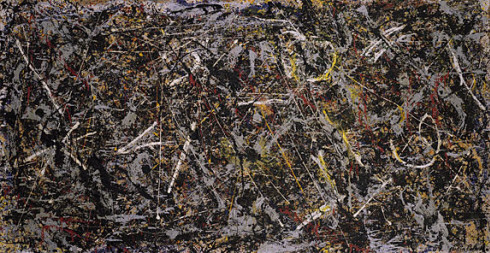
In Alchemy, Guggenheim Museum, Venice, Tamar Yoseloff presents Jackson Pollock’s 1947 painting of the same name. ‘Just when I think nothing can move me, / room after room of Tintoretto, Veronese, Bellini, / the Virgin granting me her doleful eyes, / her pearly tears, // I enter a cool white palazzo, / find his huge canvas, which shows me the truth / of water and fire, in this place / of canals and candlelight, a city he never saw’. The first stanza’s repetition, lists, end-stopped lines and abrupt termination convey the numbness we feel in the face of too much of a good thing. Besides, canals and candles are small and pathetic when compared with their elemental sources. Venice has been reduced to a cultural Disneyland. The stanza break dramatises the distance between Venice’s Guggenheim and the rest of the city’s art and culture.  Here we encounter Jackson Pollock’s Alchemy: oil, aluminum (and enamel?) paint, and string on canvas. Aluminium paint’s hardly a traditional artist’s material. It’s more suited to exterior paintwork and creates an illusory metallic effect. Have base materials been transformed into something precious, or is the preciousness an artifice? Perhaps it’s Pollock’s wrestling with the elements, a fight which links him to alchemists like Albertus Magnus and John Dee, that’s of real value. ‘And I stand before this picture, / the man who painted it / dead, like the masters shut away / in these palaces of art, their works their tribute; // wanting to pin beauty to the canvas, / dusty and flightless. But this picture lives, black / against midday sun, legions of day-glo tourists / bobbing along the canal, // and I feel tears / welling up before I can make them stop. I don’t know why; I’m tired, / vulnerable in my light summer clothes, // he and I foreigners to a faith / which isn’t ours: Christ on the cross, / the martyrdom of the saints, spelled out in / blood and gold’.

Jackson Pollock, Alchemy, 1947
Jackson Pollock, Alchemy, 1947.
Oil, aluminum (and enamel?) paint, and string on canvas, 114.6 x 221.3 cm
Photocredit: Peggy Guggenheim Collection, Venice 76.2553 PG 150
© Jackson Pollock, by SIAE 2008

In a sequence of poems entitled The City With Horns, Pollock lies at the heart of  Yoseloff’s collection and her all American bars with their tawdry neon signs are in ironic dialogue with Alchemy’s Venice. The pluralized Springs undermines the power of the new beginning, like a smoker’s resolution to quit. Line breaks are used to devastating effect as Lee Krasner ‘cooked his dinners, meat and potatoes the way / he liked, table set with a gingham cloth, / china plates, picked wildflowers to cheer / the vase, binned his gin’. The reader hopes that the wildflowers will cheer the room, cheer Pollock, but Yoseloff’s break disappoints us, as her Pollock disappoints Krasner. There’s something sad about the specificity of ‘china plates’, as it suggests that other meals were eaten from paper or plastic and the internal rhyming of binned and gin makes this gesture sound too easy to be successful. As we reach the stanza break, the hope symbolized by the crockery is transformed. ‘He threw a plate // against the wall, it smashed into a hundred / spiky scraps’. It’s a pleasure to read Yoseloff. Her disciplined technique complements the wild machismo of her subject. Yet there’s delicious, outrageous black humour here too, as, in Cedar Nights, we read that ‘Kerouac baptised the ashtray with his piss, / Rothko gazed into his glass, lost / in a haze of smoke (later he would slit // each arm, two razored lines, maroon on white)’.

Rothko - Black on Maroon
Rothko – Black on Maroon (Photo credit: markhillary)

Despite the shadow that Pollock casts over The City With Horns, the collection’s first part, Winter, offers some arresting, memorable portraits of urban existence and some beautiful language. In the sonnet, Stamps, which sits square on its white field, licked and applied, Yoseloff sees the stamp as an objet d’art. ‘Long after the letters they carried have vanished, / they flourish, unstuck from envelopes, edges / like stiffened lace, the watermark, a ghost of order’. In the world of email and printed postage impressions, the humble stamp is charged with romance and philately, once the preserve of children and obsessives, is recast as an instinctive desire to connect to a visible, tangible world.

English: 1840 Penny Black with red Maltese Cro...
1840 Penny Black with red Maltese Cross cancellation (Photo credit: Wikipedia).

In the month that saw the discovery of the bones of Richard III in a Leicester car park, the couplets of Wish You Were Here remind us of our mortality and the fragility of our relationships. ‘Men are tearing up the pavement. / They unearth Roman bones, sometimes treasure, // sometimes just the dirt / on which all of this is built. // We pick our way through debris. I show you scars, // bomb sites and brownfields’. We are reminded of how quickly we enter this archeological landfill in The Sadness of the Scrapyard, where ‘A plastic arm, tiny fingers grasping / nothing. One shoe, the other / long missing.’ This chilling image presents a loss of innocence whilst alluding to something even darker. Yet, although it’s easy to characterize the city as a dark space, Yoseloff’s vision is more complex and, in Shadow, maternal ‘Towerblocks cradle us like bookends: / I’m a slim volume, you’re / leather-bound, slightly foxed.’

New York Street Scene
New York Street Scene (Photo credit: Rhys Asplundh)

In The City With Horns, Tamar Yoseloff’s vision is forked. Yes, we encounter addiction and destruction, but we also encounter beauty and humour. Her writing is disciplined, memorable and moving.

Buy The City With Horns direct form Salt

  • Follow Tamar Yoseloff’s blog, Invective Against Swans.
  • Fomerly, an elegiac pairing of Tamar’s sonnets and Vici MacDonald‘s photography, has just closed at The Royal Festival Hall. Check out the website and buy the book here.

And God Created Woman – Stephanie Leal’s Metrophobia

Jan Gossaert - Adam and Eve - WGA09775
Jan Gossaert – Adam and Eve (Photo credit: Wikipedia)

As the Authorized Version of the Bible came off the press in 1611, the poet, Aemilia Lanyer, was not prepared to take it lying down. Her outrageous Salve Deus Rex Judæorum mounts a robust defence of Eve and claims Christ for the girls. She writes ‘But surely Adam can not be excusde, / Her fault though great, yet hee was most too blame; / What Weaknesse offerd, Strength might have refused, / Being Lord of all, the greater was his shame: / Although the Serpents craft had her abusde, / Gods holy word ought all his actions frame, / For he was Lord and King of all the earth, / Before poor Eve had either life or breath’. In Lanyer’s poetic universe, women are the patrons and Christ is their object of desire: ‘So sweet, so lovely in his Spouses sight, / That unto Snowe we may his face compare’. Lanyer co-opts the language of The Song of Solomon, turning the saviour into a hottie passed around the group, just as poets like Donne circulated their women around their friends in the form of fair copies of their poems. It lifts the soul to know that Renaissance women fought back.

Eating apples
Eating apples (Photo credit: Ло)

Stephanie Leal’s Metrophobia treats the fall of (wo)man to a spunky franchise reboot. In ‘On the discovery of the Orgasm’ , we read that ‘[…] Adam ate the apple and thought of Eve’s red lips surrounding its skin; / breaking into the soft, fleshy sweetness, he thought of other places her lips had been’. Leal, like Lanyer, sees little strength in Adam who, at this defining moment in human history, has drifted into a reverie. After all, men think about sex 8 times a day according to Ohio State University. Leal maintains tight control of her apple eating image and, at this point in the poem, Adam thinks not of teeth but of the eroticism of the apple’s ‘soft, fleshy sweetness’. However, the sibilant quality of the language adds a serpentine subtext to the proceedings. Teeth may be unwelcome in the bedroom, but they’re buried in the apple and, in the brave new post-lapsarian world, Eve threatens the selfish Adam with terrible retribution. Leal’s rhyming couplets progress the story with the nod and the wink of the end of the pier show and set the reader up for the final blow with discipline and patience.

Native Americans swearing in for the American ...
Native Americans swearing in for the American Civil War (Photo credit: Wikipedia)

In Boston Tea, Leal displays a similar affinity for the underdog. ‘Sixteen sips from Chinese porcelain / espy the arbitrary day, the decisive act. // History began mohawking the bay: / vulcanizing sand dunes’. At one level, this was a revolutionary act and the damaged cargo of tea, ‘mohawking the bay’ reminds us of the American symbolism of the disguises adopted by the revolutionaries. The leaves washed on the sand dunes have the power to violently transform the landscape, as the Roman god Vulcan was the god of lava and smoke. However, the ‘convulsing welkin / obscures feathered headdress. // The tea still washes up / on the shores of Boston; // nothing was damaged or stolen / except a padlock’. ‘Welkin’ is an essentially English, Anglo Saxon word for the heavens and suggests that, no matter what changed politically, North America was still subject to a continuity of religion and culture. ‘Nothing was damaged or stolen’ in a revolution as unrevolutionary as Egypt’s transition from President Mubarak to Morsi, whilst the Native Americans haunt the margins, obscured by the smoke drifting across the battlefields.

In Metrophobia, Leal experiments with a range of forms, moving from lyrical simplicity to cutting and pasting found objects (JM Barrie’s Peter Pan) via dense prose poems which reflect and refract the light like shattered glass. The poems are unified by a recurring suite of language and images which helps to create engaging points of contact between the fruit in the fridge and the fall of man, for example. This is a demanding, rewarding, refreshingly iconoclastic and earthy collection of poems for the way we live now. Aemilia Landon would be proud.

Buy Metrophobia from Penned in the Margins

The whole of the moon – Where Rockets Burn Through, edited by Russell Jones

William Blake's etching/watercolour "Anci...
William Blake’s Ancient of Days (Photo credit: Wikipedia)

In the days when video games were packaged in cassette boxes, their lurid covers promised adolescents the sort of ultra-violence that, in sixteen colours and with a screen resolution of 320×200, the graphics were never going to deliver. Elite was different. It came in a large austere black box and shipped with Robert Holdstock’s novella, The Dark Wheel. My imagination plugged the gaps in the crude ray traced graphics and I became Commander Jameson, launching out of geostationary orbit above the planet Lave and into the universe to trade my way to Elite status. I would close my bedroom curtains to better imagine the cockpit of my Cobra Mark III trading ship. I dogfought with pirates above alien suns, as I attempted to scoop fuel ethically from the gases boiling below me. Whenever I fire up a new video game, I feel the same excitement and, as I watch the sun setting over the Malay Archipelago in Far Cry 3, or one of today’s other offerings, my hope is that this world will be as exciting as the universe offered by David Braben in the mid 1980s.

Galileo
Galileo (Photo credit: mag3737)

In his preface to Where Rockets Burn Through, Alasdair Gray challenges our preconceptions of SF, inviting us to view the likes of Dante’s Divine Comedy and Milton’s Paradise Lost anew. He’s on to something, as ‘Paradise Lost describes a universe in some ways more primitive than Dante’s and in others more modern, because he was an English Protestant who had visited Galileo in Italy, so made room in his poem for the solar system revealed through modern telescopes’.

Xenomorph
Xenomorph (Photo credit: ElDave)

Gray’s right. The reaction to SF in some quarters makes no sense. In Beowulf, Heorot is defenceless, ravaged by the night-stalker, Grendel, and, once he’s dispatched by our hero, Beowulf has to do battle with the monster’s doubly monstrous mother. Is it just me, or does this sound a lot like James Cameron’s Aliens? We want to be thrilled and horrified by the unknown. We’re kept awake at night by our fears for the future and we’ve had no problems elevating the Gothic to the canon. Isn’t it time we took a serious look at SF?

Looking down from the Sphere of the Fixed Star...
Earth (Photo credit: Wikipedia)

Where Rockets Burn Through demonstrates the range and versatility of SF poetry. In its first section, A Home In Space, we encounter Hollywood’s epic establishing shots and the trials of the colonists. Sarah Westcott’s O, for example, presents a serifed, majuscule O floating on a white page. This O is beautiful, perfect, but also lonely and fragile; it’s a dramatic exclamation and a barely audible gasp. It’s a zero, nothing; it’s already ended. Too little, too late. Westcott’s shifting riddle characterizes the planet as playful yet ineffable. ‘what am I turning quietly and fast / in the great I am, I am here / I am bristling and crusted stripped and pocked / I am teeming and meaning what am I meaning – / where did I come from what cupped me a whole / my core and my aura where rockets burn through’. The repetition of the phrase ‘I am’ evokes God’s voice speaking through the burning bush in Exodus 3:14, ‘I am who I am’ and suddenly that majuscule O becomes an unbroken ring. Infinite. Why, when faced with such beauty, would we design rockets to burn through the aura, as suggestive as this word is of a spiritual essence, a halo crowning creation? Our violent, linear, penetrative behaviour is characterized as at odds with the planet. Perhaps it would be better off without us.

Upside Down World Map
Upside Down World Map (Photo credit: arjanveen)

The collection’s Caledonian pedigree serves as a corrective to anyone who presumes that SF’s spiritual home is the United States. Vintage Star Trek invites us to see the Federation as the United States Marine Corps and every alien species as the Viet Cong. This view of SF is pervasive: the universe is American and its way of life is under threat. However, James Robertson’s Scots dialect poetry challenges this. In his sonnet, Life on Mars, we meet a Glaswegian colonist who tells us that ‘Ma son, he’s mairrit on a Martian lass. / See, she wis made and bred here, sae it’s hame / tae her, and that maks sense. Whit’s in a name? / We’re aw jist water, astral stour and gas’. In this elegant poem, the speaker’s question, ‘Whit’s in a name?’ reminds us of Romeo and Juliet II.ii and so, beneath the sonnet’s placid surface lies hostility and families jockeying for status.

LV-426
LV-426 (Photo credit: DaltonKat2)

Andy Jackson’s intertextual Holidays on LV-426 depends on a knowledge of Alien lore, as Acheron is a desolate moon and subject to brutal weather. ‘Should have checked out TripAdvisor, / Googled up some webcams of the town’, the speaker remarks, as the poem reinvents the seminal SF horror as a satire on the package holiday to a building site. ‘Some end-of the-pier show, this. Look down / on tranquil methane seas the brochure crooned, take your ease on cliff top walks at fulgent dusk‘.

The Blind Date
The Blind Date (Photo credit: crises_crs)

The anthology also explores relationships and some of these poems are worthy of Philip K Dick. In Joe Dunthorne’s glorious Future Dating we are ‘Sat along rotating pine benches, / we wear scrolling badges that display: Name – Favourite thing – Emotional state. / I am Joe – Money – Anxious / as Porcia – Old buildings – Extraordinary / swivels into view with art deco / cheekbones, sky-rise posture’. Dunthorne’s short lines rotate the prospective dates in and out of the poem like dishes at the counter of a sushi restaurant and scroll with the snap judgements of a generation in too much of a hurry to make the time for intimacy. Dunthorne handles dystopian satire, often a leaden form, with comedic lightness of touch and reminds me of Kurt Vonnegut Jr at his finest – in Harrison Bergeron, for example.

Camera on tripod
Camera on tripod (Photo credit: Ludovico Sinz [Cane Rosso (busy!)])
The anthology also offers darker moments, and Ian McLachlan’s Red Ribbon shows the internet’s power, as the monologue’s speaker achieves twenty-three billion hits and has the forensic calm of Bret Easton Ellis’ Patrick Bateman: ‘After the pain killers have kicked in / I set to with a surgical knife, serviettes / and a little je ne sais quoi. I picked up / a following, they asked me to do a live show, offered big bucks. No. Privacy’s part of it’. The poem’s irony is obscene, as the artist behaves with the integrity of an unsigned band holding out for creative control. What’s truly troubling about this poem is that it doesn’t read like speculative fiction: the best SF speaks of our own troubled times.

Memorial to Colonel Ellison Shoji Onizuka
Memorial to Colonel Ellison Shoji Onizuka (Photo credit: waltarrrrr)

When Rockets Burn Through is an anthology with considerable ambition. SF is at once kitsch and epic, comedic and tragic, conservative and avant garde and, under Russell Jones’ curation, it is presented with appropriate passion and sensitivity. With the scrapping of the shuttle programme, perhaps astronauts are not seen by today’s children as the explorers and adventurers that they were for me. Because Christa McAuliffe was a school teacher, BBC children’s programmes like Blue Peter and Newsround focused on the Challenger mission which exploded on launch with the loss of the lives of the seven astronauts aboard. At that moment, space became more seductive and more dangerous, and Ken MacLeod’s litany, A Fertile Sea, marks that moment. Back in the bedroom, my Cobra Mark III became more exciting and more necessary. ‘Remember Komarov / Remember Grissom, White, Chaffee / Remember Dobrovolsky, Volkov, Patsayev / Remember Resnik, Scobee, Smith, NcNair, / McAuliffe, Jarvis, Onizuka / when you walk the sea-beds of the moon’.

Buy When Rockets Burn Through from Penned in the Margins

Animal Lover – Eleanor Rees’ Eliza and the Bear

Sound II - Antony Gormley @ Winchester Cathed...
Sound II, Antony Gormley, Winchester Cathedral Crypt (Photo credit: slynkycat)

During the day, our cathedrals rarely feel like spiritual places: the turnstiles, shops and tea rooms in the narthex are at odds with the stuff up at the holy end. And so it was shocking to drop out of this world and into an Atlantean realm of the uncanny in the space of the few stone steps down into the crypt of Winchester Cathedral. It was a perfunctory visit on autopilot, as I was keen to fill one of the holes in an already empty weekend. But, clambering down, I stopped short: for there, waist high in an impossible stillness of aquatic serenity, stood a man reading. For an uncanny moment I was frozen in time and space, waiting for him to acknowledge my intrusion with a glance, but there he stood. I was at the threshold of things, brushed by the draught blowing through the door.

City Street Slow Shutter (Night)
City Street Slow Shutter (Night) (Photo credit: Wikipedia)

In her collection, Eliza and the Bear, Eleanor Rees offers an unstable, beguiling and slippery collection of poems in which the darkness of the city stalks the dream-time of fairy-tales. The first part of the title poem opens with ‘I did not know my lover was a bear. // I’ve seen him bare. I’ve seen him leave his skin. // He roars. Bear-wet, grizzly – / shakes his head, crawls into bed, / places a bloody paw on my breast. // In the morning a paw mark on my skin. / It masks freckles, masks my nipple. // I did not know my lover was a bear. // I did not know he was on all fours all night / crawling the streets looking for the wilderness. // I did not know he wanted to go / back to woods and harsh brackish skies’. The homophones ‘bear’ and ‘bare’ grant the bear a Protean quality, as meaning shifts as the sound stays stable. There’s an undercurrent of deceit here, as the speaker thinks that she’s ‘seen him bare’, but how could she have seen through the secrecy of his ursine fur? Throughout the collection, Rees’ stanza structures are deeply porous. The white space between them suggests openness and fluidity but also suggests a solitary emptiness, the forced monologue of the jilted lover. What does ‘paw mark’ mean? A gentle love bite might be the souvenir of a human encounter but bears’ paws are the tools of a predator and suddenly the poem’s speaker begins to sound like a victim of domestic abuse in denial. And why does the bear need to crawl the streets all night when he his lover waits for him at home? ‘Crawling’ in the context of city streets suggests someone seeking the services of the oldest profession and the poem’s refrain, ‘I did not know my lover was a bear’ also says ‘I did not know my lover’. The poem is gloriously unstable and, in part 3, the speaker realizes that ‘the garden is in the treetops / and this is a tree house / and that the ivy on the brick work / are branches of a giant tree, / that to fall from here would land / me in a meadow somewhere / and there would be a bear in the grass / and it would have your eyes / and it would ravish me’. The successive ands create the awkward intimacy of the stream of consciousness and the bear becomes a sexual fantasy, a blend of the familiar and the unfamiliar. Its unfamiliarity and wildness shifts in our hands again, becoming a strategy to keep things interesting between the sheets.

Train Bridge Reflection on The Nile River at N...
Train Bridge Reflection on The Nile River at Night b/w, El.Mansoura, Egypt – 03 09 2010 (Photo credit: Ahmed Al.Badawy)

In On an August Midnight, Rees’ disquieting call of the wild is transposed to the city: ‘And there floating in the river of my window / are faces looking in at me. / In the midnight hot summer dark – / watching, waiting, whole. / They smile and preen / and enjoy their eyes / which glow, two storeys up, / in on me here alone – / searching for names in the glass. / Air is stiff and creaking, / weighed down by the excess / of heat and drought. // Rain is days away. / Outside is a jewel. // Dark woods over the horizon / bellow join us, join us, / and the hollow by the canal / is just as cacophonous’. One might imagine that faces looking in the window would, well, just be looking in. ‘Floating in the river’ modifies this into a disturbing and unnatural image which, in turn, feels less relaxed and even more menacing as the air is ‘weighed down’. Bodies, after all, would float without a concrete overcoat. The dark woods’ bellow to ‘join us, join us’ sounds like something from The Shining and, although it might be easy to accept that the woods, teeming with life, are capable of a bull-like bellow, a hollow is, by definition, empty, which turns the water of the canal into an especially unsettling space.

English: Coalhouse Point & the Thames Estuary ...
Coalhouse Point and the Thames Estuary (Photo credit: Wikipedia)

Rees is mistress of the liminal and Walking the Avenues evokes Conrad’s Gravesend, where ‘the sea and the sky were welded together without a joint’. However, unlike Marlow, Rees’ speaker isn’t going anywhere. She has ‘no lantern to carry / – a fiery globe in the white fog – // across the estuary mouth / to lure sailors to the rocks. // I know that ships are still leaving / down the river years before // – to Jamaica, America – // young sailors aboard with their eyes to the shore / and the girls they leave behind, // wild and red-eyed, / skin stung with the bite of the salt and the sun – // while at the end of my road / in today’s shadowy dusk // a broad-shouldered man is walking / into the thick fog, into the ether’. For a lantern to be a globe it would have a gravitational pull; women, it seems, will be abandoned and nothing they possess is powerful enough to change this. The estuary mouth morphs into the most fecund yonic image, but not even a female of these proportions is enough to keep men home and, like Conrad’s estuary, Rees’ telescopes through time, ‘down the rivers years before’ to suggest that, in affairs of the heart, the man always leaves. The undercurrent of violence seen in Eliza and the Bear is present here too, as salt is also a colloquial word for an experienced sailor, transforming the ‘skin stung with the bite of the salt’ into something casually abusive. Yet, for all his physical power, this man is also the stuff of dreams, as he walks into the ether, the space beyond the clouds, whilst the woman remains ‘tethered / by the city streets’, either as a bitch tied by her lead to the supermarket’s railings, or as a modern Andromeda to the man’s Perseus who, with his winged boots, can also fly but, in this skit on the legend, leaves her to her fate.

Wall painting from Pompeii found in the "...
Wall painting from Pompeii found in the “Casa Dei Dioscuri” (VI,9,6) representing Perseus and Andromeda. (Photo credit: Wikipedia)

Like the best fairy-stories and myths, Rees’ is an untrammelled sexuality, one centred on female experience. Her collection of poems, like a dream-sequence, appears to float between desire and experience, between the wild spaces of the city and the feral reaches of our rivers and canals. The combined effect of these poems is dazzling and unsettling, as we experience a powerful set of sometimes self-destructive desires.

RELATED LINKS

Buy Eliza and the Bear from Salt Publishing

The last day of our acquaintance – Sharon Olds’ Stag’s Leap

Titian - Venus and Adonis (detail) - WGA22881
Titian – Venus and Adonis (detail) – (Photo credit: Wikipedia)

In his Venus and Adonis, Shakespeare’s goddess attempts to seduce the youth saying, ”since I have hemm’d thee here / ‘Within the circuit of this ivory pale, / ‘I’ll be a park, and thou shalt be my deer; / ‘Feed where thou wilt, on a mountain or in dale: / ‘Graze on my lips; and if these hills be dry / ‘Stray lower, where the pleasant fountains lie’. Shakespeare presents Venus wearing the trousers: the walls of her park physically circumscribe Adonis, while her language of power would have him play the submissive role in a fantasy of female dominance and pleasure. Hunting deer was an aristocratic pursuit back in the day and, in playing the stag, Adonis is asked to become a kept man: kept by someone whose power is the word.

Defrosting window
Defrosting window (Photo credit: net_efekt)

In Stag’s Leap, Sharon Olds considers poetry’s role, the word’s role, in the end of her marriage. In Not Quiet Enough, when speculating about the divisive effect of the sounds of her passion, she then wonders whether ‘maybe / it was not my chirps, not the sounding / flesh of those sheets, floor, chairs, back / porches, a hayloft, woods, but this telling / of them – did his spirit turn against the spirit which / tolled our private, wild bell / from the public rooftop, I who had no other gift to give the world but to hold what I /  thought was love’s mirror up to us – / ah now, no puff of mist on it’. Here it’s possible to catch a strain of Yeats’ Man and the Echo which solemnises the tolling, private, wild bell as the death knell of a calculated and idealistically motivated sacrifice. After all, in Left-Wife Bop, Olds recognizes that ‘he did not give / his secrets to his patients, but I gave my secrets / to you, dear strangers’. Our discovery of our inclusion in the poem is unsettling. At least the doctor knows his patients, whereas the female writer is, once again, cast as prostitute: able to sell herself to stranger upon stranger, night after night. This is a charge which has been levelled against the woman writer since the beginning and, with discomfort, we acknowledge our complicity, our awkward presence in this failed marriage. Finally, in Years Later, we meet Keats’ immortal Bird, as ‘the body of a warbler / like a whole note fallen from the sky – my old / love for him, like a songbird’s rib cage picked clean.’

Lucian Freud
Naked Man on a Bed – Lucian Freud (Photo credit: gsz)

As the document of a failed marriage, Olds’ poems are superb but they also shine on their own terms and, in documenting the body, her language demands that we confront our physicality and mortality anew. Stag’s Leap presents an animal very different to Venus’s park bound deer: ‘Then the drawing on the label of our favourite red wine / looks like my husband, casting himself off a / cliff in his fervour to get free of me’. The irrepressible survival instinct of the husband is feral, unknowable to the human other. ‘His fur is rough and cosy, his face / placid, tranced, ruminant’ and here Olds presents this alien face as inscrutable, as we later learn in Not Quiet Enough that ‘He lived / so enclosed in himself, he seemed alive not exactly like others, but hibernating’. The ‘rough and cosy’ fur chimes with the chest described in While He Told Me, where, while Olds hears the bad news, she sees ‘his deep navel, and the cindery lichen / skin between male breasts’. This is a beautiful, arresting image of age but one which also characterises the husband as made of stone: the only part of him which lives is the surface, and this hides the man beneath. Poem for the Breasts feels like the partner piece to Stag’s Leap and the opening conceit is instantly memorable: ‘Like other identical twins, they can be / better told apart in adulthood. / One is fast to wrinkle her brow, her brain, her quick intelligence. The other / dreams inside a constellation, / freckles of Orion’. Olds sustains this quality of writing in poem after poem and, even the bra is transformed, ‘fitted with struts and ailerons, / fragile as a silk biplane’. Developing this romantic wartime image into one of transgression and polari, Olds muses that ‘It’s as if / I’d been in a club, with him, with secret / handshakes, and secret looks, and touches, / and charmeuse was in the club with us, and / ribbon, they were our wing’d attendants – / and satin, and dotted swiss, they were our / language, our food and furniture’. Yet this exotic excitement is exchanged for the dregs of a pair of cups, as Olds views ‘the empty costumes / of luxury, the lingerie ghosts of my sojourn’.

Stag’s Leap charts an uplifting journey and the final poem, What Left? is structured around independent, yet paired, clauses: ‘I did not deceive him, he did not deceive me, / I did not leave him, he did not leave me, / I freed him, he freed me’. These signal an acceptance of a once shared, now separate life and provide a fitting conclusion to what is an uplifting collection of poetry. As I write this post, Olds’s TS Eliot Award victory has gone unreported by British mainstream television news: shame. This is a collection which will speak directly to thousands of general readers and deserves the widest possible readership.

Buy Stag’s Leap from Cape Poetry

RELATED ARTICLES