Poor Rude Lines will continue to offer its regular service.
However, as Blogger in Residence at this year’s Aldeburgh Poetry Festival, I will also post to The Poetry Trust’s website. In the coming months, I’ll post close readings of work by the Festival’s poets to whet your appetite for the stellar line-up for this, the Festival’s silver anniversary. Take a look at the programme here. At the festival, I’ll be interviewing poets and curating a Poem Show for The Poetry Channel.
I’ll be talking about some of the Festival’s pamphlet poets at my Poets Preview. The details are here.
The Church of Omnivorous Light, Robert Wrigley’s first UK publication, spans a lifetime’s writing and nine collections. At times, I was reminded of the unnerving majesty of Stanley Kubrick’s The Shining. The film opens with a lyrical aerial shot of Montana’s St Mary Lake, which dissolves into a ribbon of road, winding through the dense evergreen forests of the Rockies. With the sound down, the scene’s idyllic but, when accompanied by its sinister, electronic variation on the Dies Irae from Berlioz’s Requiem, the forest mutates into something dark and forbidding. The Torrence family car looks frail and pathetic as darkness presses against it from every direction.
Shelby Cobra (Photo credit: Wikipedia)
Wrigley’s selection opens with Moonlight: Chickens on the Road, taken from Moon in a Mason Jar (1986). As the car crashes, the speaker says ‘And I listened. All through the slash / and clatter, the rake of steel, shatter of glass, / I listened, and what came / was a blizzard moan in the wind, a wail / of wreckage, severed hoses and lives, / a storm of loose feathers.’ The poem opens with the violence of a conjunction severed from its mooring, a violence we feel before it’s shown to us in the word ‘slash’. The repetition of ‘listened’ creates suspense, and we wonder how violent, how terrible the sounds were. Surprizingly, Wrigley gives us ‘a blizzard moan in the wind’. The comparatively tame snows of England’s green and pleasant land, where snow descends like eiderdown in the silence, hardly helps us to tune into Wrigley’s wavelength. The OED records that blizzard is a reasonably new onomatopoeia, and its primary meaning is ‘sharp blow, or knock.’ So, Wrigley offers us silent, overwhelming violence and sudden pain. If the automobile is the all-American symbol of individual power and freedom, then Wrigley questions it and presents us with unsavoury collateral damage: ‘the smears and small hunks / of chicken and straw.’ However, we are also presented with nature’s irrepressible powers of recovery and, following the accident which kills the speaker’s family, he ‘walked on, no longer crying, / and soon the amiable and distracted chattering came / again, a sound like chuckling.’
A FA‑18 Hornet breaks the sound barrier (Photo credit: Wikipedia)
In a postlapsarian world, there can be nothing innocent about the quest for speed, or power. In The Sound Barrier, Wrigley’s speaker reflects that ‘We were in our beds or daydreaming / out a window in school, / or we were simply running, the fleet / childish joy of motion through a still, dusty field. / It was silence that shattered.’ ‘Simply’ and ‘joy’ capture that childish innocence, but the stanza’s final line suggests that perhaps it’s the silence itself that performs the shattering: we think of air as a weightless nothing but, if you move an object through it fast enough, you’ll compress it, creating a sonic boom. Viewed like this, the air we breathe has been perverted, turned into a force powerful enough to break windows, as the cold war weaponization of aircraft evolved. ‘In 1961 I was dreaming baseball / when the bomb of air blew up. The bed / lurched, I raised my head to hear the windows / clattering in their frames, and my mother’s trinkets ringing. / And when I settled back into sleep, the room fell away. / There was a rush of dreams like stars, / the rustle of bedclothes trailing off.’
Wenceslas Hollar – Raven, crows and magpies (Photo credit: Wikipedia)
In 2003’s Lives of the Animals, Wrigley turns the tables on our anthropocentrism. In the brilliant The Church of Omnivorous Light, we encounter a congregation of magpies: ‘And you’d love their fundamental squawking, / little Penetacostal magpies, diminutive raven priests. You’d walk into their circle / like a drag queen into a Texas truckstop – / silence first, then the caterwauls, the righteous gacks.’ With a memorably comic simile, power is presented as an issue of numbers and the right clothes. Indeed, the simile reminds us that gender, and our roles at work are an affected costume drama in spurious cloths, whereas the ‘raven priests’ were born to fulfil their roles – a true vocation. From start to finish, the poem is infused with ecclesiastical language, presenting the natural world as a mystery locked even to those versed in reading its runes. In Fish Dreams, ‘She thinks the caught trout’s eye must see / a monstrous face, for after all / its slick belly boils in her acid hand.’ Invariably, poems featuring fish cause the ‘malevolent aged grin’ of Ted Hughes’ Pike to surface in my mind. However, Wrigley initially casts us as the acid secreting monsters of nightmare, but this is too easy. The first stanza ends with the pensive ‘But I am not so sure,’ and the break gives us pause for thought. ‘Could you, so landed, understand / the majesty of God might live / among ten thousand types of fire?’ the speaker asks. And so Wrigley sees the possibility of spirituality in all things, even in us. It’s just a matter of perspective.
Royal lace detail (Photo credit: Wikipedia)
In 2013’s New Poems, While You Were Out of Town sees Wrigley handling issues of absence, desire and mortality with poise and understatement. The poem’s relaxed, anecdotal style and kitchen sink setting invites comparison with Billy Collins at his best. It begins In Medias Res, which points to a significance far beyond the domestic: ‘I left the man with the steam cleaner all alone / in the house and watched from my shack / as he poured bucket by bucket the gray / brackish water that had rinsed our comings / and goings from the carpet.’ The poem’s first sentence spans five lines, accounting for most of the first stanza, which creates a feeling of restlessness, unease and hurried work. Our lives amount to little more than filth to be scrubbed from the floor, and the woman’s trip out of town feels like a rehearsal for that final absence. In the third stanza, we read: ‘And I would have noticed, had it been on the floor, / your black lacy bra, hanging by a strap / from a dresser handle, but I’m sorry, there it was, / after he left, still hanging, though I noticed it hung this time / by the left shoulder instead of the right, // as though it had fallen as he cleaned the alley / next to your side of the bed, that trouble spot / where the dog sleeps. Yes, that’s it, I’m sure, / it had fallen, and he, in one professional motion, / had put it back.’ The bra, a totem of femininity, fragility and intimacy, is violated as the house is opened for the cleaning process. Its straps modulate into shoulders as it becomes a symbol of absence in the most intimate space in the relationship, the bedroom, where individual square feet of carpet are known by sight. So sacred is this space that the speaker’s words are compelled to affirm that the bra’ was swiftly replaced, even as the sentence’s construction doubts this.
Much is made of the Great American Novel, but this selection of Wrigley’s poetry holds its own with the best of these. Wrigley tells a great story, and the selection is populated by the children, parents, rattlesnake toting faith healers, army veterans and lovers of the American West. The sublimity of the landscape, and our uneasy relationship with it, has been of interest to Wrigley since the beginning, predating any ‘eco’ label now applied to him. The poems’ political, moral and social indignation is felt throughout, and nowhere more strongly than in 2010’s American Fear, where ‘a man was not allowed to board a flight at JFK / because his T-shirt, in Arabic and English, read / ‘We will not be silent.’ Wrigley was discharged from the US military in 1971 as a conscientious objector, and this remains his difficult, essential vocation as a poet.
When my dad claimed that our cat was a bit stupid, I simmered with fury at his betrayal of a loved family member. Still, he had a point. You see, Stripy Tom did most of his chilling-out in a cardboard box under the kitchen table. An opening cut from it was aligned with a warm air vent, making the box into a most desirable residence. However, a ninety degree rotation of the box would swing the entrance away from the vent, and I’d watch a confused, stubborn cat headbutting the solid wall where the door should have been. On reflection, the charge of stupidity still seems harsh: habits and routines are deeply programmed, and how many of us could say, hand on heart, that we adapt to change any more quickly than Stripy did?
St Thomas of Canterbury (Photocredit: The Venerable English College, Rome)
Odd Blocks introduces European readers to Kay Ryan, an American poet, winner of the Pulitzer Prize for Poetry, who served as the United States’ Poet Laureate from 2008 to 2010. The titanic scale of her observations of human nature invite comparisons with WH Auden. However, Ryan’s distilled poems hit the reader with the overwhelming purity and power of shot after shot of vodka. Corners, taken from the 2000 collection Say Uncle, opens: ‘All but saints / and hermits / mean to paint / themselves / toward an exit // leaving a / pleasant ocean / of azure or jonquil / neatly ending / at the doorsill’. The exclusions to the speaker’s ‘All but’ category are an exclusive club and a symbol like the palm, often seen in paintings of saints, points to a short, grisly end. Hermits’ cells also evoke a sense of confinement and denial which, in our worldly times, represents an unthinkable level of abstinence: few of us would qualify for this club, even if we wished to. Ryan’s terse lines are themselves ascetic and, for a fraction of a second, the word exit, teetering on the brink of the stanza break, is liberated by space and endowed with infinite, potentially spiritual, possibility. Then, as the second stanza commences, this void is filled by a humdrum beach paradise. Azure has to be ground from the precious stone lapis lazuli, highlighting the destructive artificiality and materialism of this package holiday fantasy. Errors are made and, too late, ‘Only toward evening / and from the / farthest corners / of the houses / of the painters // comes a chorus / of individual keening / as of kenneled dogs / someone is mistreating.’ Ryan’s evening feels metaphorical and, read against The Parable of the Talents, darkness brings judgement and the end of time. Her sentences are anatomized phrase by phrase and pinned on the page like lone butterflies; the individualism of the poem’s painters is rendered futile. Their efforts to escape have been scattered across the house: each has tackled their task alone, and the alliterative ‘comes a chorus’ knits this disparate band into the chorus from some Attic tragedy where the wailing implicit in ‘keening’ evokes Biblical weeping and gnashing of teeth.
Easter Island Ahu Tongariki (Photo credit: Ndecam)
Neither is Corners an isolated example. In Easter Island, for example, a subtle modulation of Ryan’s form produces a small, slender, totemic poem which veers away from its anecdotal opening and into a meditation on humanity’s tendency towards destruction, and, despite being one of the selection’s new poems, it showcases Ryan’s restricted but expansive palette, as Easter Island’s statues are described as ‘a long chorus / of monoliths’: a string of long O sounds pull these single stones together into an uneasy relationship with one another.
Showery Tor 2 (Photo credit: Earthwatcher)
Yet, despite the artists’ refusal to work together in Corners, and the standoffish relationship between Easter Island’s monoliths, Odd Blocks offers the potential for something better, explaining how ‘glacier-scattered / thousand-ton / monuments to / randomness become / fixed points in finding home. Order is always starting over.’ There’s nothing sentimental here: ‘scattered’ does not impose order upon a universe governed by ‘randomness’ but, with the brief candles of our lives, our desire to map and fix coordinates adds a sense of something human to a cold universe. There are connections to be made.
Crampon (Photo credit: Patrick Gensel)
Ultimately, what impresses, beyond Ryan’s capacity to distill the everyday into a knockout concentration of thought and language, is her honesty, her capacity to see the world. In Spiderweb we’re reminded that, ‘From other / angles the / fibers look / fragile, but / not from the / spider’s, always / hauling coarse / ropes, hitching / lines to the / best posts / possible’. There’s nothing fragile about these poems either. Sure, they’re small, but Ryan chips away at her line breaks with the assurance and strength of a stone mason – and what she has created is monolithic.
Wayside shrines, flowers strung up on lampposts with a couple of turns of parcel tape, wither and rot but, once memorialized, our Facebook page will stay shiny and new. On anniversaries, the comments posted by friends and family might as well be carved in stone. To see death assume its ultimate place in the timeline of exuberant youth is surely the internet’s most powerful articulation of the tragedy of mortality. In my opinion, there’s nothing ghoulish about these memorial pages. There’s one I visit every few months, with its now poignant profile picture of a man in his prime, my cousin, walking down the beach and away.
You have 2 new messages (Photo credit: Quite Adept)
Vera Pavlova’s most memorable poems run to little more than a few words, and each sits in a field of white. Yes, that white space is oppressive, powerful, infinite, but Pavlova lays word on word with purpose, rhythm and strength. I try to avoid quoting poems in full, but Pavlova leaves me with no choice. Take 98, for example: ‘A poem is a voice-mail: / the poet has stepped out, most likely / will not be back. Please leave a message / after you hear a gunshot’. Line one’s repeated indefinite article lends the poem an aphoristic quality, but line two steps away from the universal and generalised, dropping the reader into a specific, dramatic situation. Are we hearing the poet’s greeting and, if so, why are we on the other end of the line, hoping to connect? Our voice-mails usually provide a variation on the I’m out, or unavailable theme, but this voice-mail feels unnervingly specific: ‘the poet has stepped out’. Stepped out? Where? Just now? And s/he recorded this message especially for this occasion? Then Pavlova subverts our usual certainty that our message will elicit a return call with her ‘most likely / will not be back’. And then the gunshot. In a few words, her inscrutable white page slams us hard against our sleazy tabloid culture. Faced with a total blank and a few fruity details, we leap into speculation, rather than stepping back, opening the book, and letting the work speak for itself. We assume it’s a gunshot because, through a telephone earpiece, it sounds like one, but how can we know that we haven’t heard a conservatory door slamming hard in a summer breeze? Pavlova exposes our own salacious desires and flips a finger to those who would pry into her own life. At one level, this is a disarmingly intimate collection but, at the same time, its pristine pages are inscrutable.
Anchor, Poole Quay, Customs House (Photo credit: Clear Inner Vision)
In 71, Self Portrait in Profile, Pavlova again throws her reader against this tension between the public and private, the intimate and the anonymous. Her poem reads: ‘I / am / the one / who wakes up / on your / left’. The line breaks build the poem to a crescendo, screaming out the words I AM THE ONE before undercutting this bold statement of being with a prepositional phrase, ‘on your left’, revealing that the great ‘I am’ of the speaker’s life is, beneath the surface, wholly dependent upon an other for her being. Pavlova is disarmingly honest and, like her content, her language is bare.
I’d like to go on. In poem after poem, Pavlova renders life’s joy and pain with simplicity, clarity and profundity. It’s all here: love, sex, childbirth, death. Pavlova’s voice is the calm in the storm and it just feels wrong to spoil it here. These remarkable poems belong on the page. Trust me, you’ll be the richer if you read them and they can be ordered in the UK from the LRB Bookshop.
The Golden Gate Bridge reflected in a soap bubble (Photo credit: Wikipedia)
Watching horror films, I nestle my tongue into the roof of my mouth for fear of biting it off. Whether the jolt’s caused by the hiss of a pussycat, or an acid drooling alien doesn’t matter: fear grips me. When it all gets too much, I renounce my suspended disbelief by imagining the TV screen as the cine-camera’s lens, and add a boom, bobbing up and down just above the frame. To the left and the right are tripods laden with high wattage lighting and, somewhere behind me, sits the director among acolytes. I breathe easier and relax my jaw, but this habit of seeing the bigger picture is not always calming: looking at the sky, clouds are like the iridescence sliding across the surface of a bubble. The atmosphere is a fragile thing, clutching terra firma as Earth hurtles around the Sun at 67000 miles an hour. The numbers, the vacuum, the debris flying around up there have me holding on for dear, fragile little life.
Prospect Park (Photo credit: Joe Holmes)
Oblivion stalks David Nurkse’s A Night in Brooklyn, but not so we’d notice. In The Dead Reveal Secrets of Brooklyn, ‘We are frequently asked, What is death like? // Like tossing a Frisbee in Prospect Park, / making sure the release / is free of any twitch or spasm – / and trace of the body’s vacillation – / willing the disc to glide forward / of its own momentum, never veering, / in a trance of straight lines’. Only the dead can know the answer to this question and their repetition of it sits in space, disconnected from the rest of the poem, calling into question whether the subsequent stanzas, opening with ‘like’, are voiced by the dead, or by another speaker. After all, similes seem disappointingly allusive for a poem whose title promised to reveal secrets. If the dead are still speaking, then there’s a perversity to their response, as the question ‘what’s it like?’ asks for an answer and not a simile. The simile delivered is infuriating, as the Frisbee is casually ‘tossed’ and the words ‘release’, ‘free’, ‘willing’ and ‘glide’ suggest something consensual and effortless – fun, even. Yet underneath this apparent effortlessness is a battle for dignity: nothing comes easily in life, let alone in death. A Frisbee toss only ever appears effortless: concentration and practise underpin it. In each stanza, it is Brooklyn that remains and, finally, the poem becomes a litany: ‘Remember, death does not last, / not even a breath, / whereas the city goes on forever, / Cypress Hill, Gravesend, Bath Beach, avenues screened by ginkgos’.
Brooklyn Botanic Garden (Photo credit: Wikipedia)
Nurkse’s Brooklyn, like Thomas Hardy’s Casterbridge, allows him to explore the tension between public and private, expressed in the relationship between public exteriors and private interiors glimpsed through doors, windows and alleyways. Central Brooklyn’s title invites the reader to imagine the sterile, ersatz spaces usually delivered unto us by councils and property developers. Yet Nurkse’s space is chaotic, warm, and alive: ‘Behind the tenements lay wild gardens: / a swaddled fig tree, a muscat-arbour.’ UK readers will generally associate ‘tenement’ with the most deprived communities Glasgow had to offer, rather than with a more neutral idea of rented accommodation. However, either way, Brooklyn reveals a heart to those who look closely and the ‘wild gardens’ suggest untamed passion, while the ‘swaddled fig tree’ suggests familial care of Biblical proportions. Fig and Muscat have entered the language from French, adding a sense of peachy sweetness and exoticism. Yet, at the same time, the inquisitive gaze will reveal stomach-churning squalor, as ‘I propped my forty-foot ladder against a shim / and climbed and began searing the high porches / with a butane torch. I gouged away dead bees, / resin, gum, soot from forges, caulk’. Nurkse has surprised us once already, as the poem shifts in tone from the lyrical to the disgusting, but now the reader is really wrong-footed: ‘Once / the lovers opened their blinds and watched / with pursed lips, hand in hand, her breasts / swayed slightly, his penis limp, their gaze / imperious and forgiving, and I missed a spot’. Nurkse shows that voyeurism cuts both ways and that, in the city, everyone watches. The silbilant slight sway of the breasts makes them stand out from the line and their movement shows the glorious ongoing awkwardness of the scene. The poem’s ending speaks eloquently of the passing of time and the gentrification of the borough: ‘Then I painted white on white, when I finished / those streets were empty, no one lived there / except the rich, chalk-faced in their long divorce’. The painting of white on white has a Sisyphean quality, and we wonder when he finished but, if this was a simple decorating job, then the poem highlights the rapid pace of change. However, the job could also be likened to painting the Forth Bridge, or ‘finished’ could mean when the speaker quit, or retired. This delivers a more gradual dessication of the street, as the thick, durable, flexible house paint is replaced by the thin, fragile, particulate of the lifeless, chalk-faced rich. Nurkse’s thirteen line poem of escalating surprise wants to be a sonnet, a love letter but, in the present day, Central Brooklyn is missing something: there is a void at its heart.
The Brooklyn Bridge, dawn (Photo credit: mgarbowski)
Time and again, D. Nurkse reminds me of John Donne, rebooted for the twenty-first century. Sure, to one another, the lovers’ bodies might feel like the world for a fragile moment but, lacking Donne’s exuberance as we do, we understand that we are the bees, the resin, the gum and the soot cleaned from the city to make room for the succeeding generations. The collection’s title poem ends the sequence. Short lines build and grow in length with the lovers’ excitement and with the intricacy of their imagined, pulsing borough: ‘We undid a button, / turned out the light, / and in that narrow bed / we built the great city – / water towers, cisterns, hot asphalt roofs, parks, / septic tanks, arterial roads’ but, as Donne’s lover in The Sun Rising attempts to assert his authority on the universe with rhetorical sleights of hand, Nurkse suggests that fantasies are, ultimately destructive: ‘it was time for daybreak / and we closed our eyes / until the sun rose / and we had to take it all to pieces / for there could only be one Brooklyn’.
George Shaw, Ash Wednesday: 8.30 am, Humbrol enamel on board
It’s difficult to pin down what exactly it is about a George Shaw that’s so disconcerting. At one level, there’s less going on than there ought to be. Where are the people, the traffic, the litter blowing on the breeze? Shaw often works in Humbrol enamel, and anyone who’s made Airfix kits as a child will associate a hue like Dark Admiralty Grey with the Royal Oak and Himmelblau with the Luftwaffe. To a degree, Shaw’s paintings are like Airfix models: they’re tangible but unreal. Where are the dents, the rust, the idiosyncrasies that differentiate the idea of an aircraft from an actual aircraft? At another level, there’s more going on than there should be. Standing in front of Shaw’s Ash Wednesday: 8.30 am, for example, I gradually realised that where the silhouettes of the railings and the hedge merge, the railings should be invisible, but Shaw’s brushwork renders them in sharp detail, black on black. Texture creates an unnerving second sight and ghosts appear before the eyes.
George Stubbs, Whistlejacket, oil on canvas, circa 1762 (Photo credit: Wikipedia)
Ben Parker’s The Escape Artists explores the limits of our perception, opening with an untitled prose poem in which we are invited to make our readerly assumptions: ‘Do you remember that day we found the first horse? It was skittering the dust in a forgotten field adjacent to a farmhouse that must have stood forever if not longer. This was the horse from which all other horses were bred; the horse of cave-paintings and untranslatable mythology’. All’s well so far, except, addressed in the second person, the reader does not remember this day. The power of Parker’s rhetoric and narrative requires our collusion and, suckers for a good story as we are, we are prepared to go along with it, especially for the ur-horse. However, Parker’s narrative denies our pleasure: ‘Undomesticated, rough-haired, and small, it looked like a mongrel dog. We took it to the backyard of our rented ground-floor flat. Our friends came over to see it. That’s a dog, they told us’. As readers, our side of the deal has been betrayed. Who the hell is this narrator, giving us horses and then taking them away? The poem’s second person narrative has us wondering whether we collude in this madness / deception, or is it being imposed upon us? This poem sets the tone for the whole collection: a ‘we’ has been implied but, as helpless readers, we have no way to engage with our silent partner. We are in company, yet absolutely alone. Parker’s universe initially appears to obey natural laws but, on closer inspection, it occupies a cold, lonely, other dimension.
Regression (Photo credit: Here’s Kate)
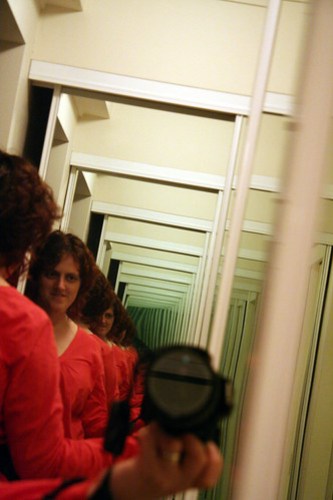
In DIY, Parker presents a stifling world: ‘On the day she left he hung the final mirror, / filling the space where the front door was / and facing inwards. Not a surface remained / that didn’t affirm the infinite regression / of itself. He walked from room to room / and knew, if nothing else, that he was there. / Only the real exists in such profusion’. Robert Browning’s Love in a Life opens with an obsessive ‘Room after room, / I hunt the house through / We inhabit together.’ Here, at least Browning’s philosophy of imperfection presents our attempts to connect with one another and his repetition of ‘room’ suggests the perseverance of a human first person narrator. Parker’s third person narrative is cold and distanced and the parenthetical ‘if nothing else’ renders the walk from room to room pointless. At least Browning has us on a search for others. Parker suggests that the best we can do is to search for ourselves and, in a world of infinite regression, the true source will never be discovered. Parker structures his poem in two septets and the line of reflection is, tellingly, occupied by an empty space.
Clothes on hangers (Photo credit: …love Maegan)
Parker’s engagement with Browning resurfaces in Remembrances: ‘A silver ring by the kitchen sink, your dress / embracing my jacket on the rail, / and on the floor those intimate blacks and reds / like crumpled flowers, lying where they fell. // By these tokens, and others, you let me know / forgetful as you are, you will return. / No sooner has the door clicked to / than I begin my search from room to room’. This home, unlike DIY’s echo chamber, is humanised with the intimate details of a relationship. However, why have ring, dress and underwear been left like fallen, crumpled flowers? Flowers may wilt or rot but ‘crumpled’ implies the deliberate destruction of something fragile and beautiful. There is a lack of reciprocation here too, as the dress does all of the embracing itself while the jacket just hangs. Why does the absent partner need to communicate through tokens? Why not just use words? Finally, we’re told that we let the speaker know that we’ll return yet, two lines later, the hunt begins, suggesting a breakdown in communication. A disturbing sense of mystery hangs over the collection, notably in One Place, where a whole sequence of potential criminal and unfaithful activity is shared with the narrator, while the ‘one place’ may not be discussed with your wife.
This is a demanding, disturbing, cold collection of poetry. Ben Parker’s deft use of narrative perspective creates a set of relationships which appear to be mysterious, even to their participants. His poems tend to move from one claustrophobic interior to another and, as the characters wait, pace, and importune every alcove, Parker’s excellent collection presents modern life as a place in which we do not even know ourselves, let alone anyone else. Escape is an impossibility.
‘I am long and pink. At first I am hard but, when you bang me, I go soft’.* I suppose I’d asked for this: my class was studying Sylvia Plath’s Mirror and I’d started with a few fruity Anglo-Saxon examples to grab their attention before asking them to write their own. The student who crafted this memorable little beauty had her peers rocking in their chairs with disgust and laughter. One way or another, our bodies polarize and provoke us.
“Anagram” from the 1633 edition of George Herbert’s The Temple. (Photo credit: Wikipedia)
In the manner of George Herbert‘s The Temple, Kevin Reid’s Body Voices offers the reader a tour through the human body. In Mouth, Reid presents us with the affront of ageing: ‘With bones showing, / their costumes worn and stained, / and no longer dazzling the crowd / with their full frontal performance, / the senescent cast hangs / rigid from the receding heavens / and lie rotting in the stalls’. Dental whitening’s carbamide peroxide promotes the West Coast fantasy of the sterile, upgradeable body, as if we were designed in and shipped from Cupertino, shiny, glossy and new. However, Reid’s substitution of desiccated and decomposing ‘bones’ for teeth reads like John Webster. There’s a consistent note of disgust throughout the poem: Reid’s pun on ‘plaque winner’ introduces stench and decay to an imagined black tie dinner. The poem’s final couplet is obscene and outrageous: ‘However, my tongue can be a prick, / “Fuckin’ this and fuckin’ that…”‘ and captures something of the spirit of John Donne’s To His Mistress Going to Bed. In fact, Donne was often in my mind reading this collection. His relationship with the body was a troubled one and he described it in his Sermons as ‘dust held together by plaisters’.
Vesalius 609c (Photo credit: Wikipedia)
It’s fitting that the collection ends with Hair. The complexities of bodily resurrection plagued Donne. How, for example, could God achieve this miracle if a traveller lost ‘an Arme in the East, and a leg in the West’? And what about the hair cut from a head through a lifetime? Reid’s lines are pitifully short: ‘In death / coarse / grey / thin / and white. // In death we part’ but, even here, the collection’s irrepressible double entendres and puns just won’t stop: ‘Death, thou shalt die’.
This is an exuberant and playful collection, loaded with ideas and internal rhymes. Reid’s recent collaboration with George Szirtes, >erasure, marks him out as someone to watch.
It was already an alcohol fuelled night when we arrived at Campo dei Fiori‘s The Drunken Ship. I was out with a Roman Catholic seminarian whose groin was in open rebellion against celibacy, and the groin, it was rumoured, was winning. In the time it took me to get the beers in, he had lured two young, uncomfortable looking Roman girls to the table. I was introduced as a photographer for a British fashion magazine and, seething at the deceit, and at my own awkwardness with girls, I set to work on the beer, sublimating my disgust at the deception into aggressive chain-smoking. Responding to the toilet’s siren song, I lurched to the loo through a storm-tossed tunnel of exceptional inebriation. It was then that I was hit: poleaxed by a man running straight at me. Stunned and confused, I peeled myself off the floor, palms flat against the wall of an improbable goldfish bowl. I clawed at my assailant, who was now leering into my face. It was then that I came to the understanding that the bar’s back wall, from floor to ceiling, was a mirror, and that my assailant was myself.
Liane Strauss, like a contemporary Velázquez, delights in the mirror’s destabilizing reflections and refractions, and there’s no wicked stepmother in sight. In Cut and a Blow Dry, the ritual trip to the salon is elevated to the status of high culture: ‘”I’m in love,” I tell you. / I’m watching you watch me / in the mirror that covers the whole wall, // like one of those vast fading maps at the Vatican, and always reminds me of a Greek trireme, / or an essence, how anyone ever got it // into this bottle of a shop front in the first place / where, through the battering gales / of the four winds from the blow dryers, // you’re always telling me to fall in love’. We might assume that the first line’s declaration of love possesses intimacy and power, but the tercet drills through the layers and we’re offered an exchange of gazes and finally their reflections in the mirror. A declaration of love, bounced back and forth is simplified into two dimensions and, as life-changing love flattens and shrinks, so the salon grows and the blow dyers assume the epic proportions of Boreas, Zephyrus, Eurus and the others. Stylist and client converge: ‘We laugh together in the mirror. / There is no difference between us’.
In ‘Self-Portrait as Myself’, Strauss’s speaker says: ‘I offer you myself instead, / today, in the image of my dead grandmother – / among my better efforts. / She’s in one of her beloved cafés, / Vienna, between the wars, / a back room, gilt and mirrors, / a proscenium of smoke, a fox / dangling from a chair-back / like a provocative suggestion. / Dark and small, in classic / clingy Vionnet, back and shoulders bare, / in quarter profile, turning, / already laughing, already / demurring, her rosewood / scrolls of hair that could have been carved by Gibbons’. Here, Strauss’s sentences fall through her pacy lines like silk draped from the shoulders and, like Cut and Blow Dry, nothing is as it first appears. ‘Gilt’ is all about the surface, and tarts up the cheap dod of wood beneath. The homophone invites us to see something sultry and Bohemian in the smoke, mirrors and tempting glimpses of flesh. The poem drifts through time and with the reference to Grinling Gibbons the 1930s give way to the 1600s. Time future is contained in time past but, whilst the speaker of Cut and Blow Dry shares a conspiratorial moment with the stylist, here the connection is uncanny, internal and genetic.
Thames – looking south from Hungerford Bridge (Photo credit: Wikipedia)
In Seduction, the poem gravitates to the centre of the page, its symmetrical ragged left and right margins evoke the city reflected in water. ‘If people can dream together, / we dream together. / This is the way it always starts: / Out of the darkness of the streets that lie between us / and the river rising like a rampart raised to part the city / from its dreamed and dreaming counterpart / across the river – a darkness falling like the leaves / shed by the street lamps every evening dreaming / they shed light and keep the city from the river – / we find our way back to each other’s side. / It doesn’t take long’. Strauss’s lines grow like the ‘rampart raised’ and the lines’ heavy alliteration also serves to bisect the poem, which evokes Joseph Conrad’s Heart of Darkness and, given the Intended’s ignorance of the manner of Kurtz’s demise, the rive gauche and the rive droite begin to look poles apart: ‘we stop and start and smile and stop again / like two strangers in a doorway, until whatever it is that parts, / like dawn the lips of the curtain, like the last look, / tears us from each other’s side’.
A clementine covered with mould (Photo credit: Wikipedia)
Little in this collection is as it first appears. Relationships shift in the light and reconfigure themselves line-by-line. Even the title of Nature Morte reminds the English speaker of the subtext behind the ostensibly bland phrase ‘still life’. Strauss’s focus zooms in on the fruit like David Lynch’s camera in the opening scene of Blue Velvet: ‘This has nothing to do with hunger. / That fruit’s been sitting out too long. / That peachy cleft’s delectable, but wrong. / That lemon is unpeeling like a stripper. / Each apple’s been meticulously rotated / just like they do it in the supermarket / to hide bang-spots and worm-holes’. In a collection all about looking, Eve’s apple does not taste as sweet as it initially appears.
Part of Ralph Agas’s map of Oxford, 1578 (Photo credit: Wikipedia)
In the days before mobility scooters, it was the ornaments and the net curtains, running in ribbons along the terraces of St Thomas’ Street, that betrayed the presence of its aged population. Smoke and hops wafted through the gate of the Lion Brewery and over the west of the city, though no-one crossed its silent threshold, and John Coombe House, my home for the year, had dipped more than a toe into the parish church’s ancient bone-yard. A headstone, bearing the sorry tale of childhood mortality in the Pumfrey family, leered at my window. In the city library, maps showed that this silent, mouldering backwater that connects the castle to St Thomas’ church had once been Oxford’s main thoroughfare. Now it was a powerful expression of the passing of time.
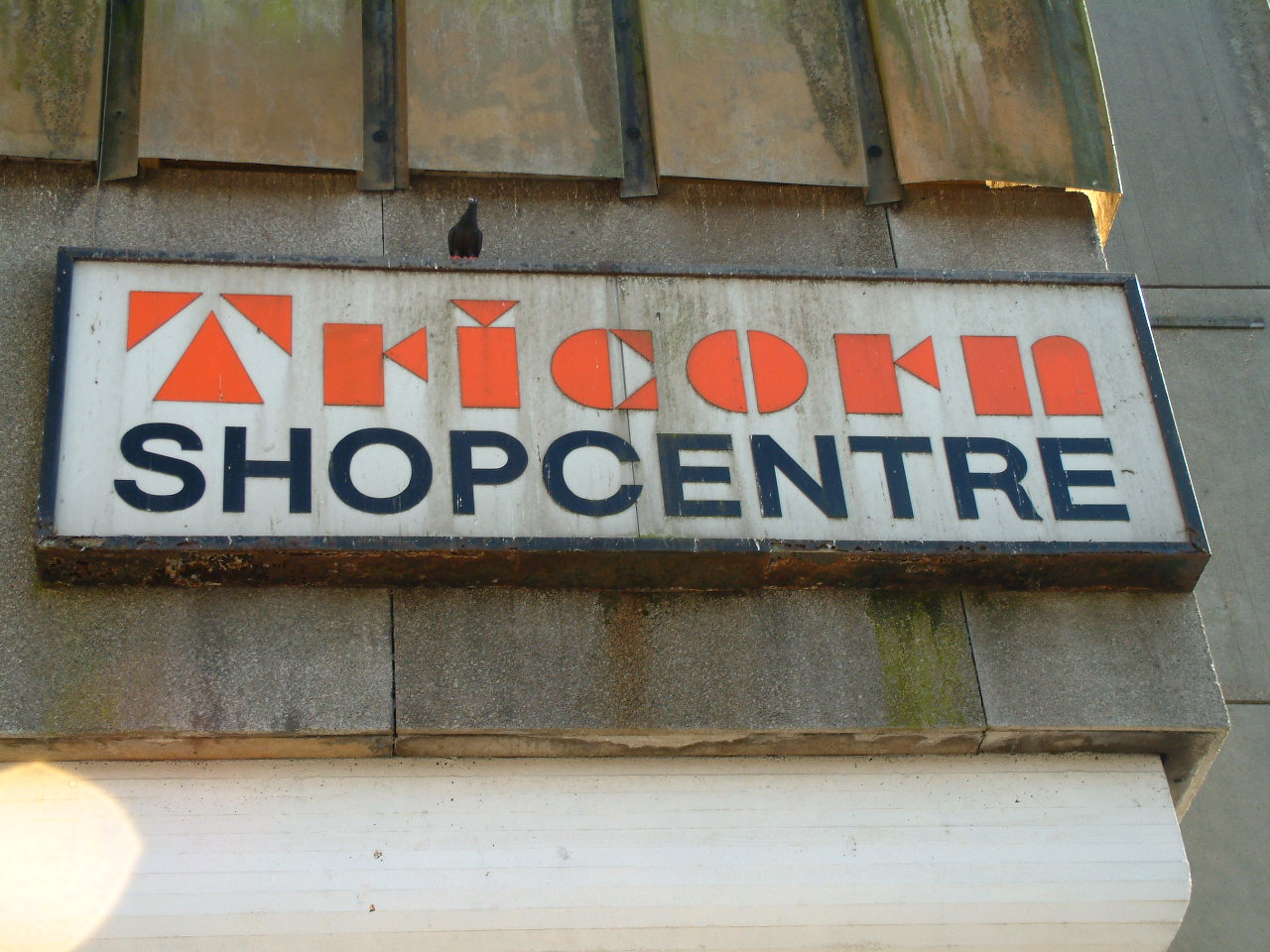
The derelict (and now demolished) Tricorn Shopcentre, Portsmouth (Photocredit: Johnfield1)
Formerly, a collaboration between Tamar Yoseloff and the photographer Vici MacDonald, charts London’s glorious dereliction. The collection is structured as a sonnet corona, indicating not only her affection for urban decay but also, through the recycling of lines from the first 13 sonnets in the final poem, the transformative power of the city. The opening sonnet, Capacity, presents the despair of poverty, or addiction: ‘Fat chance you’ll ever break out of here, / this depository for great mistakes / you’ve made your home. Just enough room / for a bed and a stool, a cell of sorts, / for a man of thin means. Lean times’. The ironic ‘fat chance’ of the expansive first sentence is in tension with the meagre fragment of ‘Lean times’. London is a city of contrasts and even somewhere as iconic as Westminster, the privileged few in the Abbey cloisters are living a spit away from deprivation. The sheltered accommodation of the poverty trap is presented as providing a stability worse far worse than prison: at least prisons are designed to hold humans. Depositories provide secure, windowless storage for superfluous objects. Yoseloff’s volta makes an unexpected appearance at line six, suggesting that, in the big smoke, uncertainty and change are the only certainties – for ill, or good. ‘But I’m a girl who’s capable / and culpable, who knows the value / of a pound. You can’t resist the give / of my carapace, my caterpillar lips, my capacious thighs’. The use of the second person makes this poem feel less lonely and hopeless than MacDonald’s accompanying photograph of Capacity House, an ugly mailing house tucked away behind Tower Bridge. However, the extended sestet throws the first line into uncertainty: ‘Fat chance you’ll ever break out of here’. Why isn’t this voiced in the first person plural? Is it poverty he’s escaping from, or a relationship? The speaker’s ‘carapace’ and the ‘caterpillar lips’ lend the poem’s sexual images a repellant quality and evoke the easy come, easy go relationships of the street.
Doors eschews the obvious subjects of crumbling Brutalist architecture and the end of Britain’s love affair with concrete. Instead, Yoseloff trains her gaze on terraced housing. ‘Rows and rows, either side of the street, / stretching ahead of her, like mirrors / in mirrors. Behind each, a different shade / of carpet; the fine dust of misery’. This first quatrain is outstanding. The repetition of rows and the thinness and meanness conjured by ‘stretching’, creates the faceless cynicism and hostility city dwellers feel when someone has the temerity to knock at the door. ‘Mirrors in mirrors’ suggests infinity and economically conveys the scale, the Sisyphean toil, that the Jehovah’s Witnesses face as they attempt to deliver ‘The Good News That No One Will Hear’. Yoseloff’s line break at ‘shade’ also invites the reader to see the street as populated by ghosts: shadows flitting behind frosted glass but never seen. Across the line break, shade is reconfigured and pokes fun at our uniform lack of imagination, as we paint our walls with endless variations on magnolia and carpet our floors with symphonies of beige.
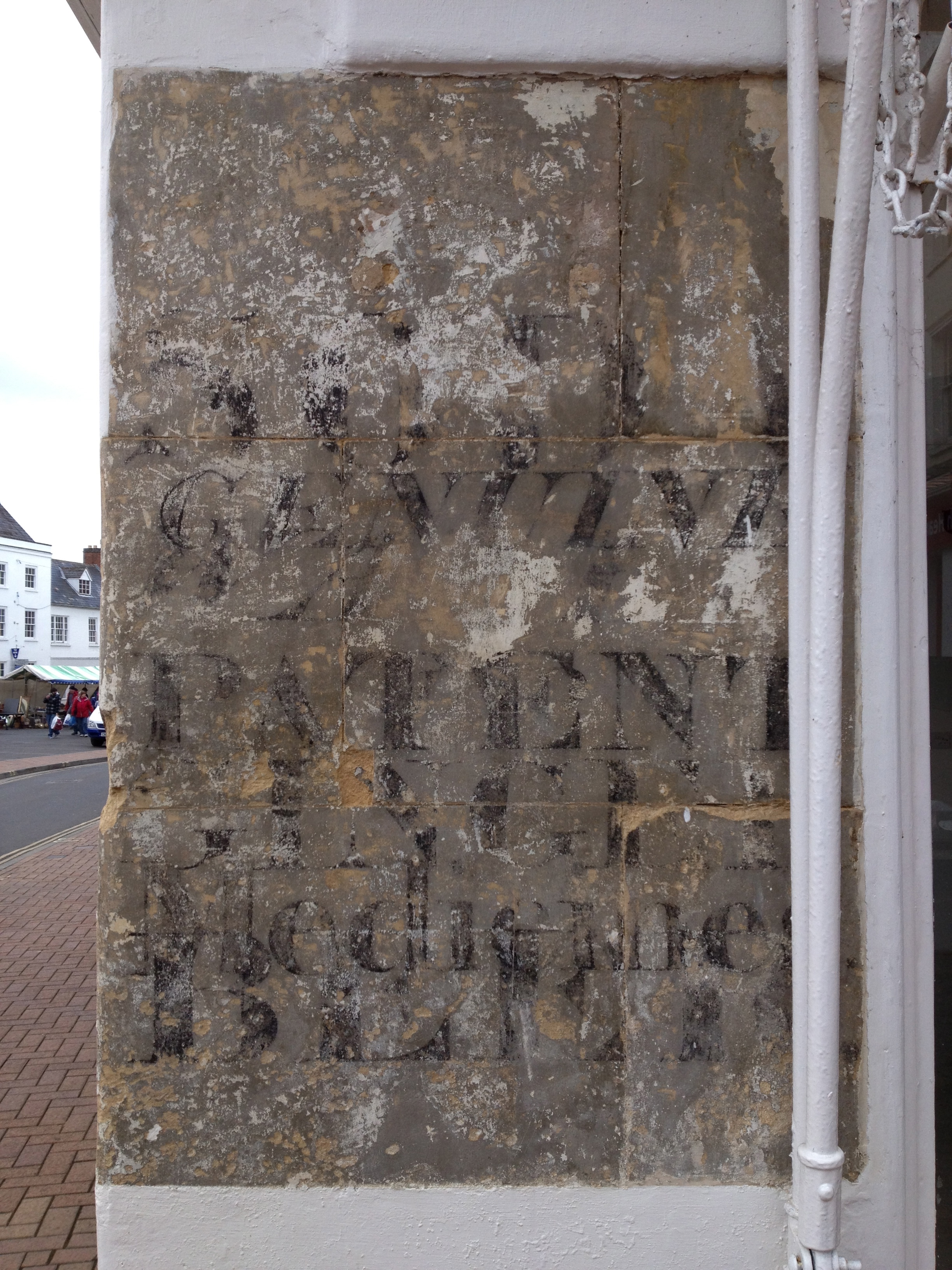
The found X-Zalia Night Cure revels in the advertising of yesteryear that, somehow, defies death, clinging to the sides of buildings and bridges: ‘for cuts, wounds, bruises, scratches, / burns or scalds, eczema, rashes, / any break or wound in the skin, / diseases caused by insects, vermin; / catarrh, rose cold, colds in the head, / influenza, poisoned blood, / piles, fistulas, leucorrhœa, / hives, shingles, diarrhœa’. The comic rhyming of leucorrhœa and diarrhœa highlights the outrageousness of the advertisement but also has an elegiac quality, as poetry flakes from our walls and leaves us poorer.
Given that the whole collection clocks in at 196 lines, Formerly achieves an impressive range. The seamier side of our great capital, the ebb and flow of its buildings and people, is captured in its lyricism, ugliness and brutality. Formerly is an intricate love letter to London and Vici MacDonald’s photographs form a rich counterpoint.
Demonstration outside a fast food restaurant (Photo credit: peoplesworld)
It’s just easier to think in shorthand. Certain brands – political, commercial, or artistic, trigger knee-jerk reactions of love, or loathing. And so it was that I entered a MacDonald’s restaurant for the first time since MacBirthday parties. I expected to loathe it, hoped even. The objective was to help some teenagers with Down’s Syndrome to order drinks of a hue which the day centre had decreed to be free of a forbidden colourant (and to get the right change which, it seems, can be quite an issue if you have Down’s). We’d hardly sat down before staff gathered for a hushed confab at the till, and they were definitely looking our way. Typical. Then a woman, who turned out to be the manageress, came to the table, asking whether we’d like to see how Big Macs are made, and soon my group was in the kitchen, being proffered with drinks and food. I had assumed that I knew how a busy, indifferent world works, but that afternoon revealed a hitherto unseen vista of human kindness. When I walk past those golden arches, arches with the power to trigger a range of emotions, I remember those young people – and the manageress of MacDonald’s, Fleet.
Bubbles – Sir John Everett Millais (Photo credit: Wikipedia)
In her prose poem, Bubbles for Reuben, Chrissy Williams presents her reader with a slice of summer: ‘Amanda blows bubbles for Reuben who chortles under the catkins. Jim watches from his chieftain’s seat, made by a woodworking friend who only just realised his wife is a whole person separate from their life together. Bubbles drift towards Jim in a cloud and his face blinks through them’. The prose poem form lends the scene the quality of a snatched Polaroid, as things as fragile as an English summer day and a lungful of soap bubbles are sketched on the page. The chieftain and his seat suggests a fulcrum, something sturdy and dependable, the still point in the community. The fact that the seat is wooden contributes to this sense of rootedness and its status as a gift lends Jim a certain authority. However, his epiphany throws his world, and ours, into uncertainty. Suddenly, ‘it’s Jim who is moving, rushing through the sunny air’ and we think again about the significance of those bubbles.
A lazy day at the beach in Irrational Games’ Bioshock Infinite (Photo credit: JBLivin)
In Flying Into the Bear, Crissy Williams delights us with the unexpected, challenging our assumptions by snatching moments of beauty from surprising places. The title Robot Unicorn Attack, for example, wrong-foots those who think that the tabloid press tells us all we need to know about video games. ‘Attack’ plays to preconceptions about the nature of video games while the first line enacts a metamorphosis, as the simile incarnates the abstract in our mind’s eye: ‘Possibility bursts like a horse / full of light, accelerating / into a star. Explosion. Hit / <X> to make your dreams / crash into stone’. This is perfect for video games, as there is no horse, just lines of code flying through a hot processor at breakneck speed. This poem also informs our reading of the collection’s title. In Penned in the Margins‘s anthology, Adventures in Form, Williams’s poem ‘this is love’ is coded in HTML: ‘<p><a href=”www.cupoftea.uk.com”>this is love</a></p>’ demonstrating that new skills are required to read the subtext of our age. Like the violent title, the line break at ‘Explosion. Hit’, goads the reader into associating video games with physical violence but the following line undermines this, reminding us that this is virtual world in which even defeat is a choreographed, aesthetic experience and simply a matter of perspective.
Into the woods (Photo credit: kern.justin)
Flying Into the Bear offers the reader a virtuoso range of forms. In The Lost, Williams offers something akin to a sonata, as her epigraph, the opening lines of Dante’s La Divina Commedia, offers the exposition: ‘Nel mezzo del cam min di rostra vita / mi ritrovai per una selva oscura, / ché la diritta via era smarrita’. The succeeding lines, culled from eight translations, riff with this material, creating something which feels like a dark version of Frost’s The Road Not Taken. ‘At one point, midway on our path in life / When I had journeyed half of our life’s way / Halfway along the road we have to go / I came to in a gloomy wood / In the midway of this our mortal life’. As we attempt to construct a text from these fragments, some roads become metaphorical, while others feel more literal. The ground shifts beneath our feet, creating something hypnotic, desperate and full of regret.
It is easy to see why Chrissy Williams was anthologized in a number of sections of Tom Chivers’ Adventures in Form, and Flying Into the Bear is an exuberant, dynamic collection in which little is as it first appears. The unexpected transforms the prosaic into something altogether more memorable.