Thank you to my brother, Peter James Field, for the banner which now graces the blog.
He’s a talented illustrator and, although most of his work is for UK and international newspapers and magazines, he also illustrates book covers. My favourite is his jacket for Vladimir Nabokov’s Pale Fire and his cover for Sandi Toksvig’s Valentine Grey was featured on BBC Breakfast last week. Well, the book was but Sandi was interviewed on the sofa with a huge projection of Peter’s cover over her shoulder.
If you’d like to commission him, contact Agency Rush.
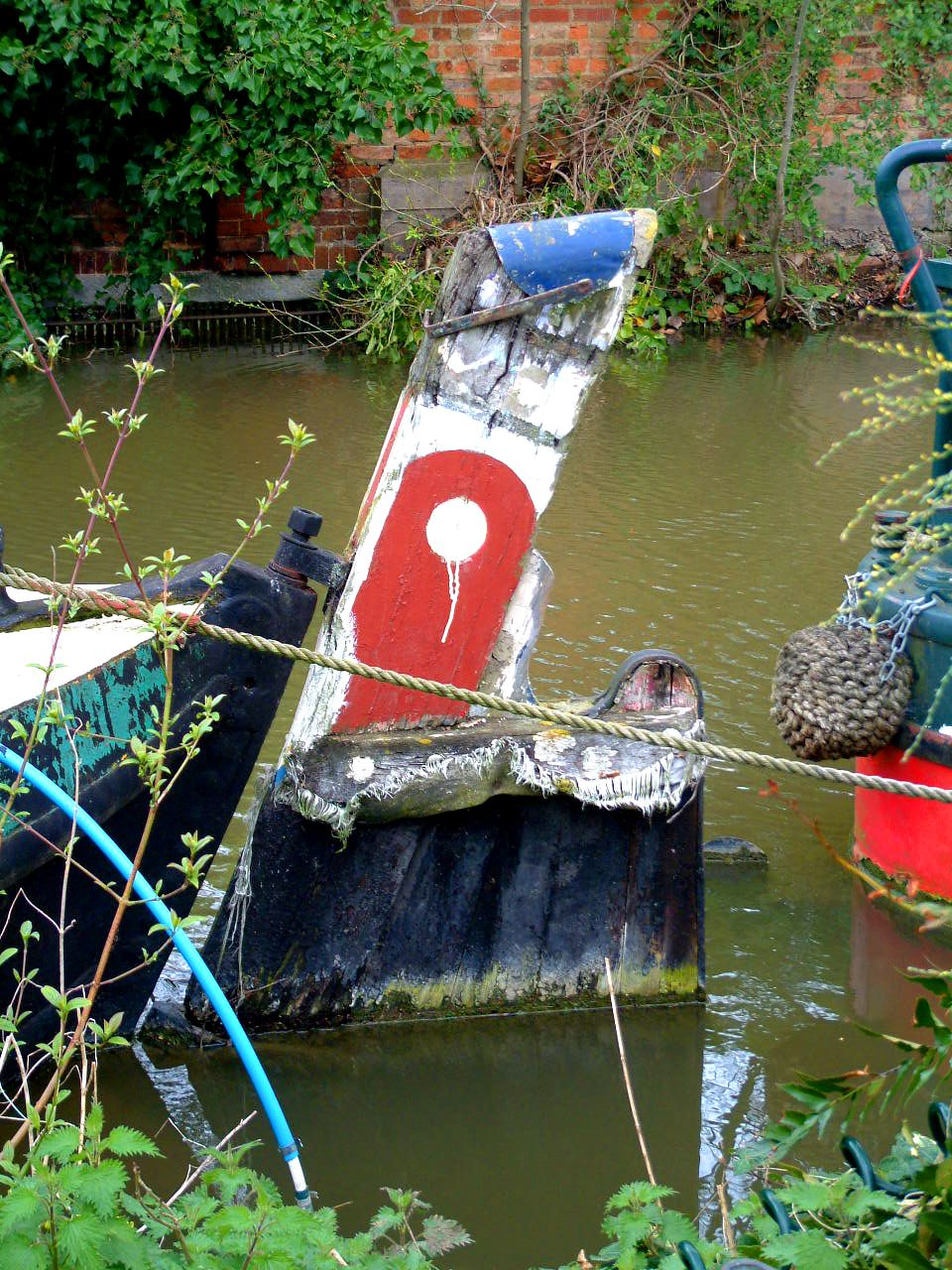
Narrowboat rudder, Oxford Canal, Hythe Bridge Street (Photocredit: John Field)
Friends were surprised when I said that my narrowboat wouldn’t prove popular with the ladies. ‘What’, they asked ‘about the shadowy swans hanging in the morning mist? What about the warmth of a solid fuel stove and the romanticism of the Bohemian ideal?’
‘A chemical toilet’, I invariably replied, not needing to mention the two feet of hanging space in the wardrobe, or the wind tunnel draughts which dragged the heavy smell of engine oil into the bedroom.
Paolo De Matteis – Polifemo e Galatéa (Photo credit: Wikipedia)
Unsurprisingly, The New Faber Book of Love Poems includes Christopher Marlowe‘s The Passionate Shepherd to His Love. The gentle insistence of the speaker and the bucolic imagery makes this poem smell of freshly cut grass and sun tan cream, as the shepherd promises the earth for a spot of action between the sheets. ‘Come live with me, and be my love, / And we will all the pleasures prove / That valleys, groves, hills and fields, / Woods, or steeply mountain yields’. Just read Shakespeare’s erotically charged Venus and Adonis if you need Marlowe’s double entendres made more explicit. Yet it’s worth remembering that the probable source for the poem is Theocritus‘s Idyl XI and the original shepherd is the giant and cyclops, Polyphemus, wooing Galatea. Given the presentation of his stinking cave in Homer’s The Odyssey, we’re left speculating about the honesty of Marlowe’s speaker. Surely the best that he can offer are sleepless, frozen nights delivering lambs in the fug of a paraffin lamp?
Other empty pizza boxes (Photo credit: Carey Tilden)
In the simple act of retitling The Passionate Shepherd to His Love as Come Live with Me, Leontia Flynn debunks the grande passion, as the retitling excises the words passion and love and we hear a metrosexual asking his girlfriend to move in with him because the bills will be more economical and, well, it just makes sense, really. The speaker leaves the bucolic behind, offering ‘a water-ring around your heart. / In the mildewed kitchenette of afternoon / T.V., my cup of coffee / overfloweth’. Even in this tawdry domestic environment, Flynn still manages to find the wiggle room to cheapen it further as the kitchen is reduced to kitchenette and the heart, the ultimate metaphor for ineffable love, is circumscribed by a water-ring. Yet, because the source material is iconic, the references to Neighbours, Ironside, Whatever Happened to Baby Jane and Flynn’s unromantic colloquial language fail to still the Marlovian pulse at the poem’s core and the audacity of love’s gestures remains.
Angel Delight (Photo credit: hmmlargeart)
In Naming It, Flynn gently mocks the certainty of youth, noting that, ‘Five years out of school and preachy / with book learning, it is good to be discovered / as a marauding child’. Her use of the line-break has a satirist’s timing, undermining and mocking pretension. However, the poem is richer than this, as the preachy twenty something is, at the poem’s core, revealed to be gloomy, baffled and prone to misadventure, so much so that being led to a clearing and offered some real education is welcome. A friend takes the speaker ‘to her well-stocked fridge [and] says: / look / this is an avocado and this is an aubergine’. Flynn and I were both born in 1974 and she’s spot on: our generation were reared on Findus Crispy Pancakes and tinned fruit cocktail and could never have conceived of dragon fruit or blueberries. Jumping back to Homer’s Polyphemus for a moment, the ability to name a thing is true power, as the blinded cyclops discovered to his cost when his mother, Thoosa, asked him who had done this and he replied ‘no one’ as Odysseus and his crew sailed away.
In Snow, it’s Flynn sailing away from the end of term and ‘Running like a girl / for the love of a fast-track train / back to the fish-smelling ferry terminal. / The sea raises a glass – rosé – to the sky at Troon’. It’s in moments like these that Flynn reveals her blink-and-you’ll-miss-it wit, as the rosé not only indicates the tastes and intent of the student drinker (see Matthew Stewart’s poem, Zaleo Rosado) but plays with Homer’s epithet ‘the wine dark sea’, indicating the significance and scale of the crossing for a younger person.
As These Days, Flynn’s debut collection, draws to a close, her placement of her final poem, These Days, contextualizes everything that has come before: ‘These days, it seems, I am winding my clock an hour forward / with every second weekend, and the leaves on my Marc Chagall calendar / flip as though they are caught in some covert draught […] These are the days / of correcting the grammar on library-desk graffiti’. However, ‘these days, like Cleopatra’s Antony, I fancy bestriding the ocean; / these days I am serious’. In unguarded moments of nostalgia, the past might seem romantic but it was always draughty and cold.
Gerard Manley Hopkins was snotty about Oxford’s outskirts. In Duns Scotus’s Oxford, he reserves his praise for the ivory towers and the river Cherwell as it coils around Magdalen College: ‘Towery city and branchy between towers; / Cuckoo-echoing, bell-swarmèd, lark-charmèd, rook-racked, river-rounded’. He describes the suburbs as ‘a base and brickish skirt’ which ‘sours / That neighbour-nature thy grey beauty is grounded / Best in’.
Port Meadow, Oxford (Photo credit: Brett Tully)
I couldn’t have felt more differently, walking up the towpath as The Eagle Ironworks‘s industrial decal of cold brick and steaming pipework floated on the canal’s surface. Banksyesque stencils transformed the steel railway bridge into an anarchist protest against the Criminal Justice Bill and the evils of capitalism but, lifting my eyes over the parapet, there was the meadow, spread to the skyline, its ragged bleak charm accentuated by the lonely ponies. If you visit when the Thames is swollen, then you’re staring at a surreal, landlocked seascape. There was nothing base and brickish about Oxford’s industrial frontier. It was a magical twilight. A no place. Utopia.
Richard Dadd – Fairy Feller’s Master-Stroke (Photo credit: Lamerie)
In Port Meadow, Oxford, 1983, David Morley’s language evokes the alliterative lines of the earliest English poetry, as the speaker is ‘Walking to Woodstock Road from Wytham Wood / where leaf-worlds welled from all the wood’s wands’. This evocation of English’s earliest heritage and a rejection of rhyme creates a timeless meeting of the old and the new as ‘leaf-worlds’ and ‘wands’ telescope our perspective into nature’s microscopic other-world of insects, or into something more magical, like Richard Dadd‘s crazed Fairy Feller’s Master-Stroke, where every leaf conceals the mad antics of the fairy folk. As Morley starts the sestet of his loose sonnet, Port Meadow is discovered anew: ‘Then a step within a fence nobody bothered with for years / or knew, except the sheep. So Nick stepped up / and through’. His exploitation of the form presents the fence as a hidden answer to the question of where they are, characterising nature as intelligent and benevolent.
Big Top (Photo credit: Joe Shlabotnik)
Margins are again explored in the sequence, A Lit Circle, which explores the Romani circus. Morley’s use of Romani language renders the circus strange, as non-Romani readers are reminded of how little they really know about it and of the lives of its performers. In Rom the Ringmaster, the Romani circus is presented as a small affair and ‘you might chiv lis sore drey teero putsi’ (you might put it all into your pocket) yet, even though it’s a cottage industry, towns are defending their margins: ‘Now they’ve JCBs, migrant crews, gangmasters. / These fields we fetched our caravans to, they’re blocked off now’. The repetition of ‘now’ expresses shock at a sudden change and the poem allows a difficult and dirty question to lie unstated in the word ‘gangmasters’ with its undertone of Morcambe Bay and the criminal exploitation of the world’s most vulnerable people. Perhaps there’s even an implied link between our current attitude towards the Romani and access to cheaper, more convenient sources of labour and Morley draws another circle, as resentments perpetuate themselves. ‘What’s gone’s goodwill along with the work. Gypsies blame the migrants. / White work-shy folks blame both. Round it goes, this hate, hurtling around’.
Trapeze artiste (Photo credit: Rojer)
The big top is in a magical, inverted relationship with the world as, ‘Outside, the sky’s firing rain as grape-shot, raking hedgerows, / knifing nests from branches, lopping leaves, exploding full flowers. // Inside, it’s raining fire-balls from the big top. The king and queen poles / blacken, primed to blow up or flash-flame’. Morley uses echoes in syntax to deepen this relationship between the tent and the world to a structural level; the tent is the world in this sense. However, the violence of the outside world towards this tent is calculated as ‘grape-shot’ was, like a shotgun cartridge, intended to maim people who were closely packed together and, ‘Inside, the horses are seizure and slaver. Scenting the rain maddens them’. The boundary between inside and outside is only a thin layer of canvas and affords little protection against an armed threat. In Saydimè the Strongman, Morley’s poem explodes on the page, a visual indication of the havoc wreaked by the gadjo assailants and the big top is shown to offer no protection but quite the opposite, as ‘The canvas is caved-in candle-mess, / locking the beasts in, gluing the flaps shut and whoever else’s trapped there’.
In Chorus, Morley’s litany of the birds producing the polyphony of the dawn chorus has the hypnotic quality of a psalm or a mantra: ‘The song-thrush slams down gauntlets on its snail-anvil. / The nightjar murmurs in nightmare. The dawn is the chorus’. The kenning ‘snail-anvil’ again links the here and now, in the form of the birth of Edward Daniel Keenan Morley, with the language of Beowulf. The poem also reminds us of Psalm 148‘s litany of praise, or perhaps even of Nick Cave’s Breathless, in which the whole of creation is exhorted to praise, even the ‘Mountains and all hills, / fruit trees and all cedars! / Wild animals and all cattle, / creeping things and flying birds’. This is a collection which celebrates nature’s beauty.
In Enchantment, Morley’s use of alliteration and repetition breathe life back into some of the nation’s earliest recorded forms of poetry. The effect is hypnotic. Morley’s vision of nature is lush and magical and, through the Romani people, we are reminded that although margins may be contested places, they are also places of great and strange beauty.
Cover of The Velveteen Rabbit. (Photo credit: Wikipedia)
My childhood soft toy, a blue waistcoated Peter Rabbit, is a mess. You might expect him to be threadbare after a life in service but he’s missing an ear, buttons and, crucially, has my name emblazoned upon his right leg in huge letters, so that he didn’t go astray in hospital. This chimes with the words of the Skin Horse, one of characters in Margery Williams‘ The Velveteen Rabbit, who describes becoming ‘real’ (loved) as a process in which ‘your eyes drop out and you get loose in the joints and very shabby. But these things don’t matter at all, because once you are Real you can’t be ugly, except to people who don’t understand’. Okay, sentimental this might be but the core message rings true: to love someone, or something, is to be prepared to make a sacrifice.
Prague, Wenceslas Square during the Velvet Revolution. (Photo credit: Wikipedia)
In Angel of Prague, Doty’s speaker exists in the present tense excitement of the Velvet Revolution in which his role is to proclaim a revolutionary message from the façade of a church, dressed as an angel but ‘then I must balance // on the narrow pedestal, or lean / against her stone back to support myself, / which is all right until I look down / the cold dizzying storeys to the pavement // and gradually find myself furling / the cloth around her stone shoulders, / my legs trembling; it’s hard to hold out // your arms when you’re frightened / of being dashed on the stones below, and in a while I slink down, back into the crowd’. A city’s guardian angel is supposed to stand at the sharp end, protecting the city from fire, plague, or what you will. Just take a look at the archangel Michael, putting himself out there to defend Rome from plague atop the Castel Sant’Angelo; it’s not easy being an angel. Doty makes vertiginous use of the stanza break to present the void beneath the word ‘balance’ and, in the next line, the word ‘lean’ again abuts space. This refusal to take a personal risk might be seen as unloving but perhaps Doty’s conclusion is that any ideology, liberal or totalitarian, is not worth the sacrifice.
Pipistrellus pipistrellus in flight. (Photo credit: Wikipedia)
Mark Doty’s opening poem, Pipistrelle, also presents the conflict between ideology and the speaker’s companion Charles’s desire to, at all times, look steadily at his subject, as Wordsworth expresses it in his Preface to Lyrical Ballads. The poem’s speaker, looking at the bat asks, ‘Is it because I am an American I think the bat came / especially to address me, who have the particular gift / of hearing him? If he sang to us, but only I // heard him, does that mean he sang to me? / Or does that mean I am a son of Whitman, / while Charles is an heir of Wordsworth?’ Doty’s ability to question America’s sense of purpose and confidence makes him at once both an insider and an outsider, an American and one who would ask awkward questions of the US’s sense of vocation to support and spread democratic government. The poem begins with deftly sketched details that present his reader with a vivid sense of place and beauty like the ‘two twilight mares’ who ‘ignored us / and went on softly tearing up audible mouthfuls’ and the pipistrelle bat which ‘fret[s] the spaces between boughs / with an inky signature too fast to trace’ but becomes bogged down with questions. Doty rehearses a crisis of confidence and the heavy presence of Charles, the speaker’s alter ego, creates a sense of competition. Finally, the natural world steps in and ‘Shh, / says the evening near the Wye. / Enough, say the hungry horses. // Listen to my poem, says Charles. / A word in your ear, says the night’. After the speaker’s confused ramblings, the imperatives and end-stopping of these final lines endow nature with the power and decisiveness to make modern man shut up and enjoy the silence.
Puritan statue, wrecked, Cambridge Common (Photo credit: Boston Public Library)
Pipistrelle’s references to the reading of Whitman and Wordsworth indicate Doty’s view of the importance of literature as a means of making sense of the world. This theme is developed in The Word and Apparition (Favorite Poem). In The Word, whose title plays with the opening of John’s Gospel, we’re presented with the statue of a puritan, a pilgrim, on a busy New York intersection, ‘White cotton cap, immaculate shoes / and stockings, black coat over starched dress’. Black and white suggest clear-cut moral teaching and the starch in the dress indicates a stern, unbending position. As she points to scripture, Doty’s language of beating, striking, wearing and shredding implies her tough position. Yet its location, ‘in the station at 34th Street and Sixth Avenue, // on a bitter night just after the turn of the year’ asks us to consider whether Christianity and its attendant moral teaching has anything more than an aesthetic role in the daily life of the new millennium, pushed to the margins as a cultural legacy, or does the statue’s location at an urban hub indicate its ongoing centrality?
Fallen colossus of Ramesses II, Ramesseum (Photocredit: Wikipedia)
In Apparition (Favorite Poem), Doty begins by implying the former, that twenty-first century society has disconnected from the texts it once set store by. ‘The old words are dying, / everyone forgets them, / pages falling into sleep and dust’ but then the speaker encounters a fourteen year old reciting a poem in a bookstore: ‘He makes the poem his own / even as he becomes a vessel // for its reluctance to disappear. / All right, maybe they perish, but the boy has the look of someone / repeating a crucial instruction / that must be delivered, word for word, as he has learned it: // My name is Ozymandias, King of Kings / Look on my Works, ye Mighty, and despair‘. Is the boy’s recitation an analogue of the forgotten Ozymandias‘s vainglorious inscription, or is the fact that the boy ‘makes the poem his own’ proof that the old words, the old values, are not dying? Re-reading The Word, it’s hard not to read echoes of Ozymandias into the statue of the puritan woman. Who cares about the rock upon which America was built, as we run for trains and queue for coffee?
Body, Pompeii (Photo credit: Phil Dokas)
In Theory of Beauty (Pompeii), children produce another epiphany, as the speaker sees a girl queuing with her mother in a café. ‘She’s reading POMPEII… Buried Alive! with evident delight. / Pleasure with a little shiver inside it // And that evening, I thought I was no longer afraid / of the death’s head beneath the face of the man beneath me’. Has childlike wonder endowed death with enough aesthetic quality to draw its sting? ‘I thought I was no longer afraid’ suggests that it did but only for a short time.
In Theories and Apparitions, Mark Doty seems to acknowledge, like Margery Williams, that love requires bravery, faith and the ability to take a risk. However, his poems view these ideals through the filters of frailty and fear, which makes them a tender, forgiving exploration of the painful business of being.
Audrey Hepburn in Breakfast at Tiffany’s. (Photo credit: Wikipedia)
Perhaps the little black dress epitomises haute couture because black is the perfect foil for a dirty great swag of diamonds. At The University of Oxford, subfusc, the institution’s distinctive academic dress of black gown and white bow tie is flamboyant enough to see students on their way to exams, dinner – or the pub – waylaid by tourists’ cameras. Add a bottle of Bollinger and you’re transported straight to Brideshead. However, the word’s Latin origin, subfuscus (rather dark), points to the mortification of the body at a time when most of the men at the university would have entered the church. Black also evokes nefarious nocturnal shenanigans and, one imagines, has always been the colour of choice for poachers and housebreakers, for women wearing diamonds and for men blagging them.
Subfusc on Merton Street, Oxford (Photo credit: Lawrence OP)
In Man in Black, one of Caddy’s epigraphs is taken from Johnny Cash’s Man in Black. Cash’s line ‘I wear black for the poor and beaten down,’ promises a collection of poems of protest and solidarity. Later in the song, Cash sings that ”Till things are brighter, I’m the Man in Black’, suggesting that he’ll dress in drabs until judgement day. The revolutionary desire of this song and Cash’s doubtfulness about the possibility of effecting change provides Caddy’s poetry with a sombre, pessimistic frame.
Johnny Cash (Photo credit: Heinrich Klaffs)
A Silence Opens, the collection’s first poem, ostensibly presents a village in decline: ‘No one I know or heard of / wants to live there now. / There are no signposts to the road. / The village bank closed long ago’. The abrupt end-stopped lines indicate that the village is dead but the present tense ‘wants’ reveals this as wishful thinking and the village continues to eek out its meagre existence. The locals retreat into a nostalgia which Caddy wryly characterises as racism and right wing politics: ‘Gnarled old-timers fretful, densely frugal, / hateful of the French and Labour, / long for pitchfork days, leaning into gates, / following distant hares, coursing’. As I write this post in North Oxfordshire, many cars carry bumper stickers demanding the repeal of Labour’s 2004 Hunting Act. So, perhaps Caddy’s Dorset village also functions symbolically as a countryside which feels itself betrayed by Westminster and his poem is an inverse of Heaney’s The Early Purges. In 1966, Heaney writes that ”Prevention of cruelty’ talk cuts ice in town / Where they consider death unnatural, / But on well-run farms pests have to be kept down’. In 2007, Caddy’s ‘holding grows thin / at the end of a dwindling track’. The paradox of growing thin points to the sheer effort involved in agriculture, even when it’s in decline.
Cranborne Chase (Photo credit: Wikipedia)
In Bloody Shard Gate, Caddy presents the past echoing through place names. ‘At this intersection we encounter a site / sticky with saps without visible signs / of earth stumbling things,’ he writes. That the place is described as a site to be encountered indicates that something significant happened there and that the place still has an indefinable presence. The lack of visible animal tracks reinforces this otherworldliness. Bloody Shard Gate near Cranborne Chase was the site of a fierce battle between gamekeepers and poachers and this conflict between the law and the men in black is presented with resistant ambiguity: ‘Still again in darkness ungrounded / spark, spots, throbbing blood clots, / cut-ups, pulsing bodies in semi-arrest, / far beyond Boehme’s dialogues, split // entrails, polyphonic Albion’s anti-furies, / the stubborn refusal to exonerate / and the crushing possibility that all / Truth is a shadow except the latest’. The poem’s internal rhyme creates a sense of secrecy, locking in its events as the reader is locked out. Albion’s polyphony rejects a single voice and whether we see poachers as heroes or villains is unclear: ‘all Truth / is a shadow’.
The Wounded Cavalier by William Shakespeare Burton (Photo credit: Wikipedia)
This fascination with names, places and history is sustained and, in Easter Day, ‘Restless vandals crawl through The Hangings’. Forests have ever been a magnet for criminals and outlaws and their ‘crawl’ recasts them as quadrupeds, as belonging there like the ‘lactating badgers intent / upon sunken worms’. Caddy’s poetry is richly observed and evokes place powerfully. ‘There’s an underlying resonance, / abandoned Cavalier, windscreen / empty and junkies , oblivious to cold / and possible squall, high / and blanked // Nearby farmers or poachers shoot / at rabbits or deer or gypsies’. The Cavalier is a superb detail: evidence of the lawlessness and magnetism of the spaces far from the watchful gaze of street lights and CCTV cameras. The Civil War hit this area hard and Caddy’s playful substitution of a dead Cavalier for an abandoned one suggests that all that changes is the nature of the litter. Looked at this way, abandoning cars could be seen as progress. The speaker’s uncertain attribution of the gunfire makes a similar point. In a few hundred years, the game of cat and mouse between poachers and those who would manage the estates remains unchanged and, in fact, there’s little in Caddy’s eyes to distinguish between them. The dark humour of ‘or gypsies’ adds a final, grotesque piece of common ground between these opposing groups, reminding us that, when it comes down to it, country folk are country folk and outsiders can go to hell. They share the right wing politics of the gnarled old-timers from A Silence Opens.
In Man in Black, Caddy requires his readers to sing for their supper. Most of the time this feels right, as intriguing places and names present us with questions and not with answers. Caddy’s exploration of Dorset history and landscape draws playful, illuminating parallels between the past and the present, and comments powerfully on the decline of the village.
Only someone who follows no football can understand the feelings of confusion and fear that accompany the convergence of their personal diary and a major fixture. I’d just moved to teach English in a ballet school, which is a fair indication of both my knowledge of and interest in the offside rule. Unpacking complete, I took a stroll in the heat of the early September evening, intending to dine out but, as I hit the High Street, I witnessed a frenzy of male excitement. The town was a writhing mass of tattooed, bare flesh: lampposts had been scaled and the drumming against road signs and shop shutters gave the crowd’s noise a tribal quality. To me, the scene was straight out of Bosch or Bruegel and if this sounds like hyperbole, it isn’t: that evening, England had beaten Germany 5:1, which explained why the pavements and roads had disappeared beneath a flood of humanity. I headed back the ballet school, resigned to sleeping hungry. Alcohol rarely shows the Brits at their best. Cafés and restaurants in Venice can leave tables and chairs outside at night but, in the UK, this would be taken as a request by the restauranteur to have them thrown through the windows.
Zaleo Rosado (Image credit: Zaleo Wines)
In Tasting Notes, Matthew Stewart’s second HappenStancepamphlet, his decision to juxtapose the advertising spiel and the wine’s own thoughts has a satirical aftertaste in the case of Zaleo Rosado, the winery’s Rosé. The spiel talks of raspberries and freshly cut roses, marketing the wine as the alcoholic equivalent of Eton Mess and a game of croquet. However, Stewart’s poem presents a different perspective, as the wine’s light, informal voice tells us that ‘At times I’ve heard it said I blush. / Well, wouldn’t you, if popped and poured / in some High Street pub, surrounded / by a gaggle of squawking girls / who hurl you back without a thought?’ Booze, the Rosado recognises, dupes customers with the pretence of a macho hierarchy: we expect spirits and export lagers to deliver a blokey alcoholic punch but rosé legitimizes the hen night bender. Even the winemaker sniggers at the Rosado, recognising that it hasn’t ‘got the guts for red’ but here’s the modern marketing genius as, served in 250ml ‘large’ glasses, there’s nothing sophisticated or light about it. Its summery veneer offers the ideal pretext and Stewart’s final rhetorical question convey’s the wine’s indignance. Take the plight of the Benedictine monks at Buckfast Abbey, Devon. Tucked away in their monastery they brew Buckfast Tonic Wine but Strathclyde Police linked it to 5000 crime reports in three years: one in ten of these offences was violent.
Zaleo Vines (Photocredit: Zaleo Winery)
Zaleo’s Pardina, made from the region’s indigenous white grape, is treated to the same advertizing copy as the Rosado, as raspberries and roses are replaced by bananas, apples and limes. However, Stewart’s poem exploits the mutability at the heart of wines that don’t keep. The Pardina tells us: ‘I wait all summer long, the last / to be picked. Dust builds on my skins.’ In these opening lines, the brief summer season is shown to be long in the eyes of this fleeting wine and we’re invited to imagine the kid who’s ‘picked’ last for football, where a game lasts an age. Dust is a Christian symbol of mortality and the Ash Wednesday cross of dust, marked with a thumbprint on the forehead, tells us that from dust we were made and to dust we will return. So, this word, applied to the grapes’ personified ‘skins’ lends them a human frailty. Stewart’s control of line breaks leaves his reader left dwelling on words like ‘last’, ‘ebb’ and ‘decline’. These poems, deceptively restrained in ambition, pack a punch nevertheless. In performance they read well but are doubly rewarding on the page.
I’ve held this post back until the supermarkets started their Christmas booze advertising offensive, as Matthew Stewart’s offering a few Zaleo wine deals here. Not only does he write poetry but he blends wine and runs the commercial side of the Zaleo winery. I also felt a bit of a fraud writing about these poems without sampling Matthew’s produce, so, if any friends and family are reading this, I’m hoping for a Christmas awash with Extremadura’s finest Tempranillo and Pardina. I apologise in advance for exposing my tattoos and damaging road signs.
I was standing at the counter of a Belfast tourist office watching as a biro was waved over a map. ‘And then there’s the Titanic Quarter‘, the girl said. The boy in me was delighted. ‘What’s in the Titanic Quarter?’ I asked, imagining a replica of the Grand Staircase and Kate Winslet’s Empire line charms. Her face twitched in discomfort before she fetched her supervisor. Defensive comments about a proposed museum were muttered but the eyes of her junior, now in a position of deference behind her, said it all. They widened and her head gently shook: ‘Stay away!’ they said. ‘There’s nothing to see there’. Belfast’s marketing strategy was five years ahead of the city’s amenities and, somewhere behind the Falls Road, the threatening graffiti preaching death to prots had turned on the property developers pricing locals out of their city. Belfast was changing before my eyes, changing so fast that it couldn’t keep pace with its own idea of itself and, as with these things, it was hurting.
English: Racing yacht ‘Valkyrie III’, 1895. Photograph by John S. Johnston of New York City. (Photo credit: Wikipedia)
In Belfast, Leontia Flynn presents a city in which ‘The sky is a washed-out theatre backcloth / behind new façades on old baths and gasworks; / downtown, under the green sails of their scaffolding, / a dozen buildings’ tops steer over the skyline’. As the curtain rises, the set is impressive but, as you pass an hour or two staring at it, the chips and dents of the heavy touring schedule soon reveal the chipboard reality behind the spray-painted fantasy. The word façade reminds us that, fundamentally, nothing but the window dressing has changed. However, this is a balanced stanza and the next two lines inject a note of optimism, as the builders’ tarps are envisioned as sails: a seemingly effortless method of propulsion. Suddenly, the poem’s grubby industrial opening is transformed and the 180° horizon over which the buildings steer promises Belfast a clean slate and the opportunity to boldly go.
Belfast (Photocredit: Wikipedia)
In the sonnet, Pastoral, Flynn’s octave shifts the scene indoors, presenting an affluent on-trend city enfolded in Ikea’s warm embrace like the rest of the UK: ‘CDs stacked alphabetically, / the shelves distressed artfully, the hardwood boards / which have off-set the bright white colour scheme precisely’. The -ly suffixes chime together with good taste and coordinated care. This could be any home in any city but ‘My father squints at an atlas in search of Kentucky / and whistles the opening bars of ‘Memory’ or ‘Roddy McCorley‘ / into his Fairtrade coffee, absent-mindedly’. Only in Ireland could a song recounting the execution of a participant in the 1798 rebellion rub shoulders with a Lloyd Webber number. When the Belfast mind is ‘absent’, the past bubbles over. It lurks, even in a bright white room with distressed shelving. As the sonnet closes, the speaker’s family either remain uncomfortable with their new role in the bourgeoisie, or they hardly dare hope for a brighter future: ‘And if we should stray to the subject of prices of property / we do this, strictly, in the spirit of self-parody, / or very quietly. Time passes slowly, / calmly the lights come up on this calm Sunday’. The repetition of the word ‘calm’ in the final line jars, making us, like the family, wonder how long this calm can last.
Pantheon, Rome (Photo credit: Wikipedia)
The collection’s title, Drives, reminds us of journeys and the distance between places. Perhaps it’s for this reason that the collection visits so many other cities: Casablanca, Monaco, Beausoleil, Barcelona, Rome, Paris, Berlin, Washington and New York. It feels as if Flynn is measuring her home town against them. In Rome, the first stanza presents the tawdry debasement of a world heritage site: ‘Rome! I would like this postcard of the Pantheon / (in Rome!), and also this magnet of the Colosseum’. For many, the city’s power has been lost amidst cliché and cheapo plastic knick-knacks. And when you’re looking for culture? ‘There’s too much Rome in Rome’. You can see where Flynn is going with this – Belfast might be a small city but it still feels like an authentic town. It’s small enough for people to know each other. Tourism hasn’t stripped it of its heart and soul and replaced them with a white mug and T-shirt with ‘I ♥ Belfast’ emblazoned across them in American Typewriter.
Road sign for Derry (Photo credit: Wikipedia)
For Flynn, these distances also signify other things and her title poem, Drive, evokes Dennis Scott‘s Marrysong, Brian Friel’s Translations and Tom Paulin’s A Spruce New Colour. ‘My mother’s car is an estimable motor, // The car in which my mother, / during a morning’s work, will sometimes drive // to Dundrum, Ballykinlar, Seaford, Clough / ‘Newcastle’, ‘Castlewellan’, ‘Analomg’. / They drive along the old road and the new road – / my father, in beside her, reads the signs // as they escape him – for now they are empty signs, / now one name means as little as another; / the roads they drive along are fading roads’ and the couple become strangers in the own land and potentially strangers in their own marriage.
Flynn’s collection is accessible, yet charts Northern Ireland’s breakneck drive into modernity with fairness and a note of guarded optimism. Her writing is restrained, technically assured and rewards close reading, as does her superb Profit and Loss.
English: Satellite view of the Uffington White Horse (Photo credit: Wikipedia)
The world’s weirder than we imagine. On a whim, I drove to the Uffington White Horse for the winter solstice. After the night had transitioned to an oppressive slab of grey, I followed the Ridgeway to Weyland’s Smithy, a long barrow, and noticed the smouldering bonfire first. Then, taking in the rest of my surroundings a little more carefully, I saw the pentagram chalked on one of larger stone lozenges. In the entrance were some tied grasses and an eviscerated hare or rabbit. What, I wondered, would I have seen a couple of hours earlier?
In Bonehenge, John Hartley Williams initially presents neolithic sites as stripped of their power and appropriated as lovers’ lanes. ‘Millicent Bean and her lover, Pete / (of Pete’s Klutches-While-U-Wayte) / disturb the long grass round a neolith / at midnight, under a lupine moon’. Williams’ names already invite associations with DH Lawrence’s Lady Chatterley’s Lover, or Robert Browning’s darker Porphyria’s Lover. We can picture the white van in the car park, as we’ve read about Pete’s Klutches from its side and, suddenly, this couple are not alone. That the grass has been disturbed suggests that the tryst has violated hallowed ground and the luridly supernatural lupine moon points at Millicent’s own desire to ‘savour ghosts / of ancient rites’. Williams has a lot of balls in the air here, and the reader is unbalanced, unsure whether to see this piece as comic, or as something altogether more disturbing. This uncanny uncertainty is itself masterly Gothic. As the couple consummate their lust, Williams presents the moon shrinking: ‘The pewter orb is pinched and held / as if by a jeweller’s fingers: a pearl’ and, in a scene of pure horror, ‘From the disappointed caves of every- / thing, resurrected ritualists arise / and reach out bony claws to grasp / Pete’s ankles, Millicent’s quicksilver curls’. Why are Williams’ resurrected ritualists initially so keen to hold onto the couple and why, once their seed has spilled on the ground, does it ‘repel the weave // of tangled limbs that shrink away like / snail horns touched, or shrivelling worms, / into their labyrinth’?
Español: Réplica del techo de la cueva de Altamira, expuesta en los jardines del Museo Arqueológico Nacional de España (Photo credit: Wikipedia)
Williams visits similar neolithic territory in The Old Men Behind the Waterfall. As Bonehenge’s labyrinth is a suggestively yonic image, so this poem opens as ‘Shadows murmur in the moist vault’. Cave paintings are universally admired, yet Williams again strikes an ambivalent note. ‘Prophetic age? Or time of stupefying?’ he asks, suggesting that ‘Ideas are millionthed in ash or simply / dashed by tower’s deluge in boulder pools of clarity / where fish below the churning of the force / are bleak-green silver dull or swift and pendant and unsullied’. There’s no optimism here and Williams lines grow in length until they overwhelm us. The fish have remained unchanged for millennia. We usually like to see them quicksilvered like Millicent’s hair but Williams’ ‘bleak-green silver dull’ reinforces the bleak beauty. However, the torch still shows ‘a pyrotechnic script on the walls and evokes Belshazzar’s Feast from the Book of Daniel, presenting the reader with mixed messages. Are our best efforts at creating meaning just daubings, or are they divinely inspired?
Line art of scalpel. (Photo credit: Wikipedia)
In White Asparagus, Williams continues to unload his images of castration and loss of potency. Bonehenge’s ‘snail horns touched’ is a superb image and here asparagus, our beloved aphrodisiac, is subverted as ‘Underground, the spears were being lifted / by practised hands. The severed phalluses / jolted by in the back of a tractor’. There’s a sense of unfulfilled desire and separation here too, as Williams tells us that Beelitzer Spargel, Brandenburg’s characteristic white asparagus, was a mystery to West Berliners until the wall came down.
Caravaggio painted Bacchus twice: once following illness where the skin tones match the foreground’s peaches and once as a semi-sozzled teenager (although the foreground’s decaying fruit carries dark undertones). So, Bacchus is supposed to be the god of parties and of resurrection, yet booze’s image problems and health issues complicate this picture. In Williams’s words: ‘My old friend! Your gut protuberant, your horns / palely curved, your tongue claret-sticky – / how good it is to see you! Take the weight off your rump. / I think we’ve listened to this plopping music before, / have we not? This lucid glugging? / Tall-stemmed glasses catching fire from light’. Williams’ long lines create the inertia of the public house and of The Old Men Behind the Waterfall. Is the pub a place where anything is ever achieved, or has wine had humanity talking nonsense since the golden age of Greek civilization? Those glasses catching the light should be reminding us of the cave paintings too. What, William asks, is the value of any of this culture? (He later asks explicit questions of poetry in Poets). Finally, Bacchus’s phallic horns point to the later shrinking of libido and fears of castration.
In Café des Artistes, John Hartley Williams restricts himself to a tight palette, working his colours with the claustrophobic intensity of an obsessive compulsive disorder. Many of these poems also present images of startling beauty, as Williams questions us and our place in the world, taking nothing for granted.
You lash out at the strange and frightening; you lack the ability to control your bowels; you’re helpless and depend upon your loved ones to feed and dress you. Whether you’re a cutsie little toddler, fragranced with wholesome mother’s milk, or a urine scented and demented geriatric makes all the difference to this picture. It’s a shocking dichotomy, as the pensioner will have paid a life-time of taxes, contributed to society and possibly even have fought in a world war. All the baby’s done is to soil a few nappies. Dying’s one thing but, in these days of medical progress, extreme old age is in a different league of fear. The elderly offend the eyes of our cult of youth and are wheeled into darkened corners to exhale their last few years before shuffling off. To make matters worse, cases with video evidence like the abuse at Castlebeck’s Winterbourne View unit, Hambrook, must be a fraction of the abuse out there. Society’s relationship with the elderly is broken, the love institutionalised out of it.
Paul Durcan (Photo credit: Menage a Moi)
In Praise In Which I Live and Move and Have My Being, Paul Durcan meditates on encroaching old age and a number of the opening poems frame it positively. In To Brian Friel on His Eightieth Birthday, the ageing persona’s lust is recalibrated as he gazes upon ‘Irina – a bitterly attractive young middle-aged French woman’ not only with ‘golden tresses’ but also ‘buck teeth’ and the speaker feels like ‘an old ram looking into a plate-glass shop window / Unable not to see [his] horned visage peering back out’. Yes, there’s something hairy and animalistic about this image but the horns and the old age echo the likes of Chaucer’s Januarie from The Merchant’s Tale – there’s something pathetic, ridiculous even, about this lusty old ram.
Carry On Doctor (Photo credit: Wikipedia)
In The Most Extraordinary Innovation, Durcan continues to pursue the comic potential of geriatric libido: ‘What an extraordinary thing it is to be nursed! / Ordinarily I’d be skulking in my den! / Nursed! All of a sudden to be taken in hand, / In the public ward of a general hospital, / Mayo General Hospital in Castlebar, / Nurtured, nourished by a female stranger!’ The poem flits between the maternal and picture postcard smut and presents a romanticized image of nursing that makes old age look like an appealing proposition. Given that elsewhere in the collection Durcan touches on the banking crisis and the fatal wounding of the Celtic Tiger, his faith in society is touching.
The poem is proceeded by one of the collection’s many elegies, Maureen Durcan, a poem that, despite its positive outlook, undermines the Carry on Doctor elements of Durcan’s tone in the earlier poem. The speaker becomes ‘A grain of sand’, insignificant and worthless and Maureen Durcan’s final question juts against the void of space at the end of the poem. This uneasy position problematises the poem’s warmth and twee butterfly image. ‘”While you were sleeping, Paul, I died. / Isn’t it the most glorious morning!”‘ The full stop following died is a termination. How I want to believe in the poem’s miraculous resurrection and final line of apparent optimism.
Traditional Tuesday (Photo credit: P1r)
However, Durcan’s collection plumbs the cold, deep, still water in Thinking About Suicide, a deserted Gethsemane of suffering. ‘Estranged from my family, if I do not soon / Take my own life, others will take it from me – / Hooded males with knives in their tracksuits // Or medics in their scrubs prancing corridors / Or cowpat-faced ward sisters smirking / Or ice-cold proprietors of old people’s homes’. Here, Durcan’s in the icy reaches of investigative journalism and the faceless converted town houses in our localities, townhouses concealing rooms the sizes of cells and professional carers unknown to family members. The collection is constantly on the move, however, and this, its darkest poem, is undercut by Self-Pity, the poem which follows hard on its heels.
Pete Postlethwaite (Photo credit: spannerfilms)
Pete Postlethwaite’s King Lear was physically shocking. On the heath, virtually naked, his emaciated body drew a gasp. Looking back, his cancer must have been advanced and he was working to spite it. For me, Lear is Shakespeare’s greatest play, charting the absurd comedy of a man first stripped of his power, dignity and then stripped physically too. Postlethwaite’s brokenness haunted the stage like a memento mori. I’m not trying to suggest that Durcan’s Praise in Which I Live and Move and Have my Being is King Lear but Durcan’s collection is a meditation on growing old suffused with his trademark humour and dark despair. Death stalks this collection, yet Durcan closes with Free Travel Pass and, with his signature use repetition, he grinds his excitement into the reader. ‘Having received a lecture on the dangers of codeine, / Instead of my credit card I hand the cocky young female pharmacist / My Free Travel Pass. / She also snaps at me: / “Sir, that’s your Free Travel Pass.” / “Oh, so it is!” I cry. “Forgive me! / I have only this very morning / Received my Free Travel Pass and / I am so – so hyper – is that the word? / How I’d love to tango with you!” / She glares a very, very PC glare’. With these vertiginous swoops from high to low, Durcan makes the cold feel very cold indeed.
Post Live Aid, I’ve always viewed the charity concert or album with cynicism. Sure, the cause is worthy but you wonder whether the preening stars are there for that, or for themselves. Down at English Pen, Sophie Mayer has been busy editing Catechism: Poems for Pussy Riot. This collection is different. Sure, there’s a celebrity contribution from Phill Jupitus but, as a stand-up comedian, he knows the value of free speech only too well. Besides, having a poem published in an anthology like this hardly smacks of self-promotion. As George Szirtes writes in the introduction, ‘I am fully aware that [the anthology] is unlikely to affect the course of events in any measurable way […] It might be a consolation to Pussy Riot, and to those for whom they speak, that there are many people – including poets – who listen to them and talk back in support’. The harshness of the sentence and the Russian Orthodox Church’s support for Putin looks, to a Western liberal, indefensible. Szirtes goes on to say that, ‘Since Putin seems assured of the power, it is rather surprising that the courts should have decided to act as severely as they did. […] The charge of ‘hooliganism’ is rather like the one of ‘parasitism’ that was directed at the Nobel Prize winning poet, Josef Brodsky in 1969. It is broadly seen as a charge of convenience. In that sense Pussy Riot has grown from a minor nuisance to a global cause. They are up there with Brodsky. A crushing and oppressive two-year sentence becomes very big news. The result is that Pussy Riot look, as they actually are, highly intelligent while Russia looks cruel and stupid’.
English: The Kremlin, Moscow. President Vladimir Putin addressing Russian Orthodox Church hierarchs. Русский: МОСКВА, КРЕМЛЬ. Выступление на встрече с иерархами Русской православной церкви. (Photo credit: Wikipedia)
The anthology is broad in range. At one end of the spectrum, Andrew Bailey’s clerihew Poem for Pussy Riot is clean, classic, polemical and drips with bile. ‘O presidential hands, that can / break tigers and bend frying pans, / you know from judo too much force / may be revisited on its source’. The seething anger and stanza form nod to Percy Bysshe Shelley’s The Mask of Anarchy, a reminder of an age when British poetry really had some bite. It’s interesting to note how often the poets in this anthology use the rhyming couplet, satire’s straight razor, to sharpen their spleen. So, in one sense these poems are of the moment but, at the same time, some of them could have been penned by the likes of Alexander Pope.
Aoife Mannix‘s ‘The Eye of the Needle’ penetrates to the heart of the Russian Orthodox Church’s hypocrisy. ‘I bet when Jesus went into the temple / and started knocking over stalls, / there were those who said this is just / some punk from Bethlehem pulling a / PR stunt’. For my money, Mannix nails the betrayal of Christian values at the heart of the church’s decision to collude with the Russian state. The word ‘Punk’ works hard here, capturing Jesus’ back to basics, anti-establishment rabble-rousing and suggests the title of the Pussy Riot song ‘Punk Prayer: Mother of God Drive Putin Away.’ (Given this title, didn’t Pussy Riot attend church to pray?). However, the word also means prostitute, suggesting the indignation of many Russians at this sacrilegious, naked performance. As the poem lists Putin’s material goods, it builds to an angry crescendo, terminating with the satirical slap of a rhyming couplet as Putin is addressed: ‘you are just an echo of that other Pilate dictator / who also thought he could cling to power / by torturing those that seemed weak / but knew the strength of turning the other cheek’.
Phill Jupitus (Photo credit: IRGlover)
Phill Jupitus also spots the irony here, observing in Girl Banned that ‘As a child / I sang in church’. Of course, when you stop and think about it, the Christian message is a revolutionary one and to sing it in church is to preach that revolution. Jupitus’s series of allusions to faceless bubblegum pop girl bands demonstrates Pussy Riot’s value: they’re a real band with the courage to provoke an authoritarian regime. ‘But cold hard Vladimir / Remained unmoved / Called their rock folly / so they weren’t / Girls allowed’.
Jody Porter works to great effect with Pussy Riot’s Wikipedia entry in http://en.wikipedia.org/wiki/Pussy_Riot. ‘The neutrality of this article is disputed,’ she begins. ‘Please do not remove this message / until the dispute is resolved’. Porter’s poem succinctly draws the battle lines, as human rights lawyers argue that Pussy Riot’s arrest is a distortion of the law and a blow for free speech, whilst many Russians believe that their custodial sentence was a fair one.
However, the anthology’s scope is broader even than this and, in Chella Quint‘s In Vogue, she exploits the faux contemporary demotic of the fashion world to point the finger sternly at us, at our degeneracy and bandwagon hopping. ‘I need to get an awesome balaclava quick. / It’s London Fashion Week and they’re totally sick’, she begins. And suddenly we’re back where we started, watching Patsie and Edina scouring Bond Street for couture balaclavas.
Visit English Pen, decide what you think the anthology’s worth and download your copy now.