
Broad Street was in summer mode: conga lines of language students sporting identical backpacks following the sign of the brolly raised aloft, selfies at the gates of Trinity College and my wife and I, juggling a two-year-old and a five-month-old through the scrum and into Blackwell’s to scratch my poetry itch. Claire Scully’s cover illustration spoke to me, and so I pulled Richard Meier’s Misadventure from the shelf.
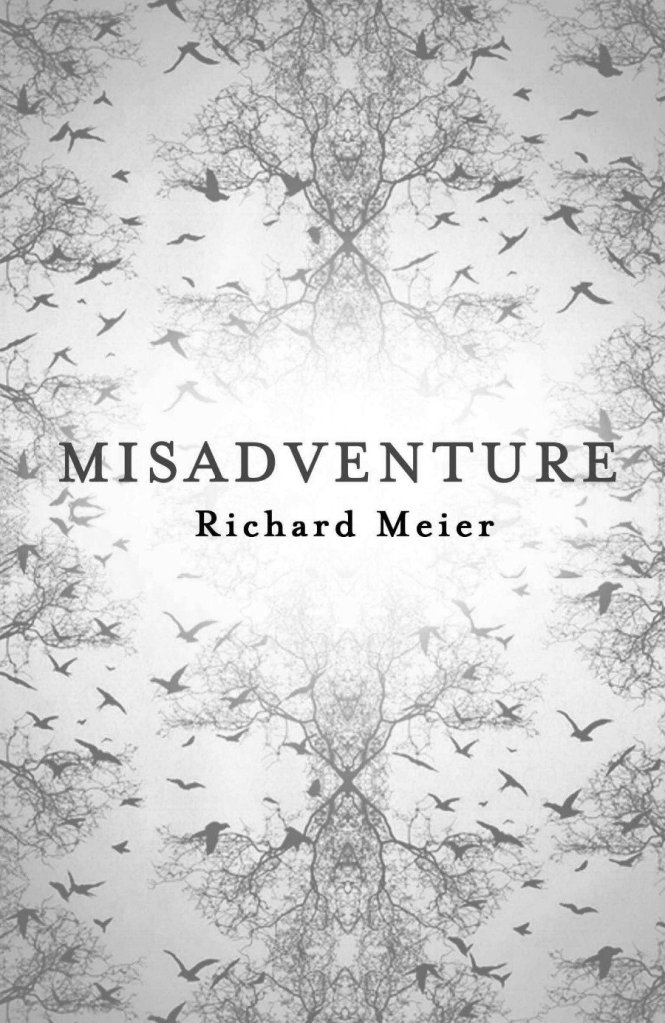
I started at random with ‘Blackberrying in a time of recession’: ‘You can’t eat those ones, darling, / I tell Matilda as she tries, / as she tried yesterday, to pick the last / blackberries at the bottom of the garden.’ Shiny new dad that I was, this was in my hit zone: ‘tries’ and ‘tried’ suggesting the Sisyphean challenges of parenthood so lightly. I was sold.
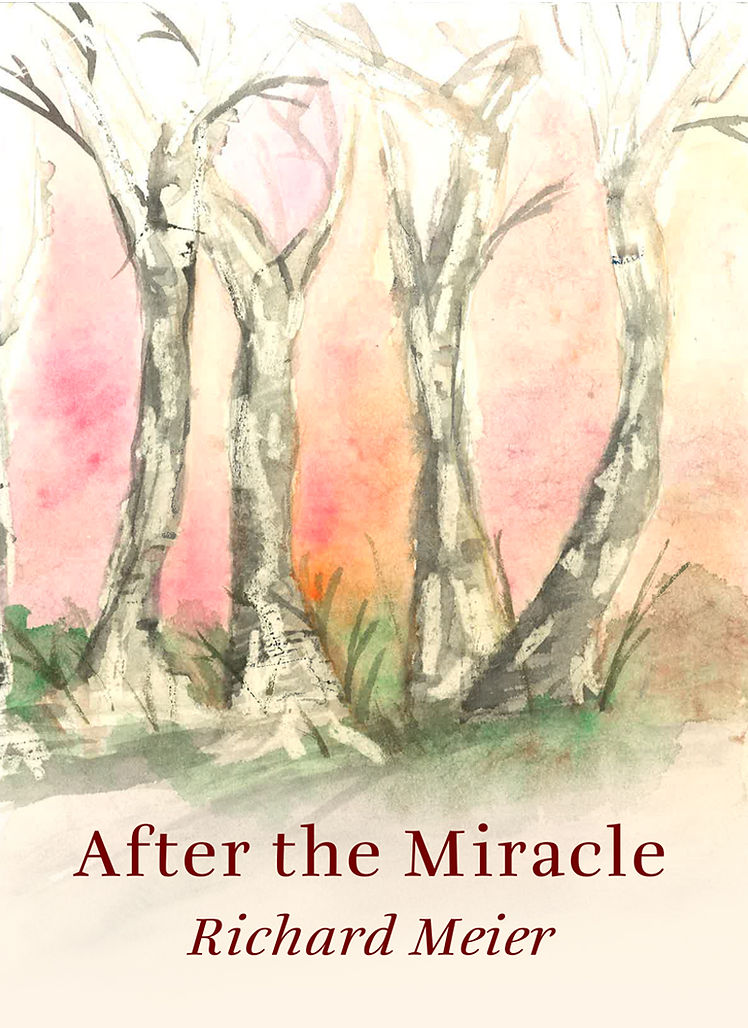
And here I sit, with Richard’s third collection, After the Miracle, and, turning from the painting on the front cover to the image credit on the back cover, I read the name ‘Matilda Meier’ — the very same ‘toddling, student daughter’ from ‘Blackberrying in a time of recession’. To have one’s daughter illustrate the cover of one’s book – oh, be still, my heart!
In ‘Muscle Memory’, we’re on ‘A wide, blank beach in northeast Norfolk’. Given that there’s a poem called ‘Sea Palling’ in Misadventure, I cannot help but imagine Meier’s beach as this one. Glorious in summer, its ‘wide, blank’ qualities offer families the space and freedom to play, but there’s a brutality here too: spend the day outside, no matter how slathered you are in sunblock and, come the evening, lashed by sand and wind, your skin will smart. Meier’s poem, built from couplets, enjoys space on the page. The son’s final throw becomes ‘a template for all future beauty. / And on the boy’s face, as he gets it // and as the world falls open slightly / to show its workings, oh the joy’. Meier finishes with a trademark flourish – the absence of a full stop – pointing beyond the beach, and into the future. The ‘arc’ and the ‘template’ point the geometry, the physics at the heart of things. When the world falls open in a poet’s hand, we brace for another encounter with the numinous but, instead, we glimpse the Earth’s ‘workings’: its un-numinous numinousness!
At the heart of the collection sits ‘Sketch of a Pagoda’, an homage to Takuboku Ishikawa (1886 – 1912) – known for frank, personal, observational poetry. Here, every word is weighty. One reads:
Your using the word we
to mean not you
and me
[Devastating thing]
In the summer of 2020, and a couple of miles south east of Sea Palling, my children and I sat on a bench outside The Dunes Café above Winterton beach but, that winter, after severe coastal erosion, it was demolished. Visiting today, you would never know that it had been there. The pronouns we use to shore-up our lives lack the solidity we endow them with… and rhyming ‘we’ with ‘me’ ought to sound trite – but here it works. No, it doesn’t just work – the poem unleashes its body blow from this elemental simplicity.
My father still speaks in the first person plural, and it cuts when I hear it. I couldn’t tell you when I last had the sense that my mother knew who I was and, when I visit, I also visit the ghost of my great aunt who, late in her dementia, looked just as my mother does now. In the final section of the collection, ‘From Memory’, Meier trains his eye on his mother’s dementia, and on its impact on the family. He opens with ‘Spiral’: ‘It started with some dates she got mixed up — // her illness, yes, but also / our watching her / closely, as if through glass’. ‘Our’ again. We imagine the discussion dissecting the visit in the car and note the uncanny effect of viewing the mother as both part of the family and apart from it, divided by the unbridgeable barrier – we see one another, but the ferry’s been cancelled.
To look a thing in the face, to call it by its name and, through some alchemical miracle, to turn life in its joy, its mess, its pain, into gold – that’s the calling of the artist, the musician, and the poet. Richard Meier’s poems are of this class and, as I walk the next few miles of my journey, I’ll have After the Miracle tucked into my back pocket.
Buy After the Miracle from HappenStance
Related Links
Read Helena Nelson, Richard’s publisher, on After the Miracle
Richard Meier’s Misadventure, reviewed on Poor Rude Lines, December 2012
 Poor Rude Lines
This is lovely, John. Really lovely. x
>
LikeLike
Pingback: Peace to all on this Cluttered Earth | Wear The Fox Hat