
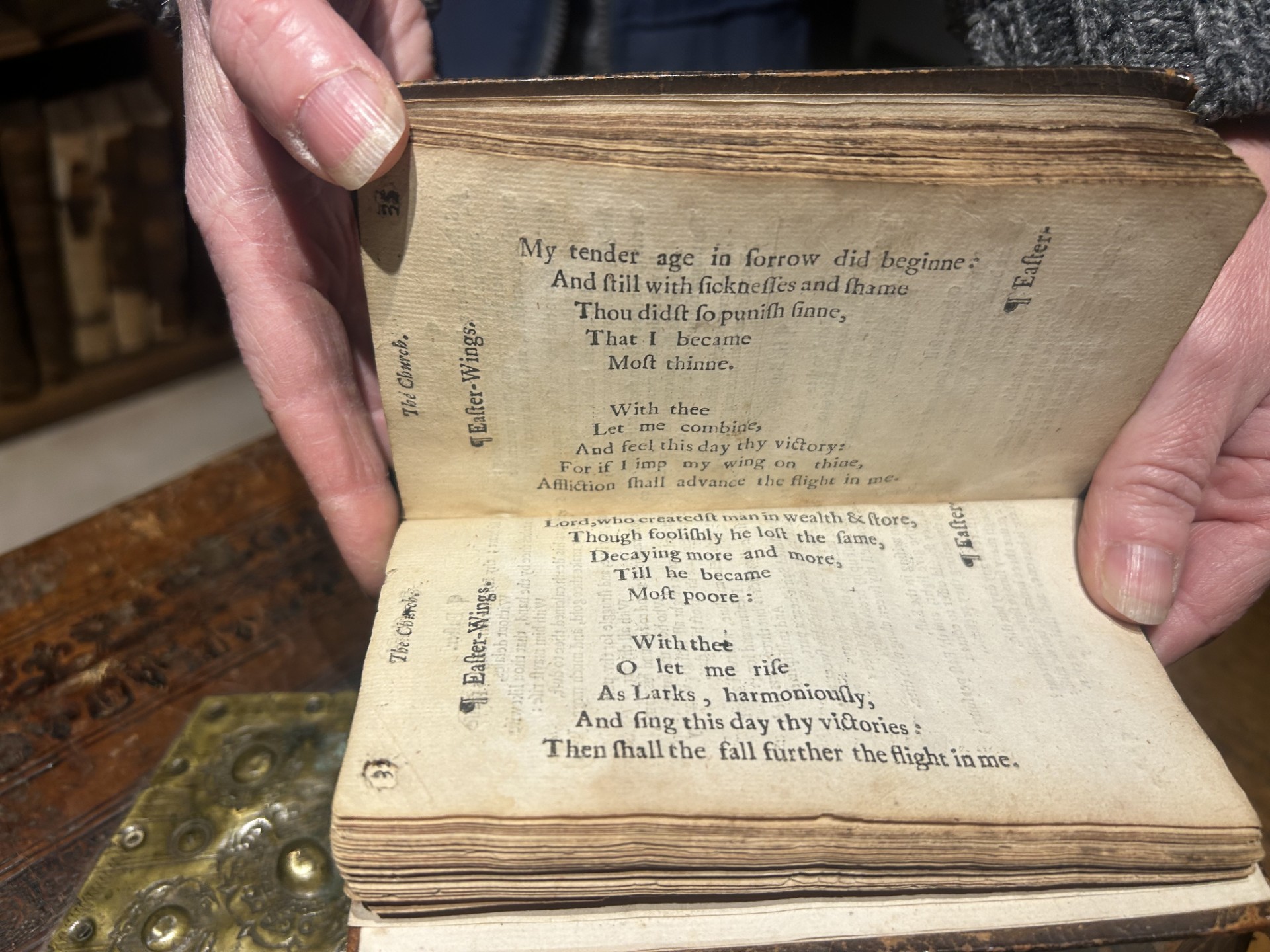
After a chance remark about George Herbert, the librarian pulled a small volume from the shelf: leatherbound and plain, scruffy but serviceable. It opened to ‘Easter Wings’, Herbert’s iambs restaging sin and redemption where, after a process of subtraction, we become ‘Most thinne’ and ‘Most poore’ but, ‘With thee’, we grow, as ‘Then shall the fall further the flight in me’. I could feel the type pressing into the poem from overleaf and could imagine the printer tugging at the handle of the press. The result? A palpably handmade ink-splattered artifact, printed in 1633 – the year that saw Galileo guilty of heliocentric heresy. Visiting modern bookshops persuades us that certain texts are omnipresent: here’s your choice of editions of Hamlet. Here’s Dickens. There’s Woolf. Perfect. Mass produced. Ubiquitous. But, at that moment, I saw ‘Easter Wings’ – a little miracle of survival, carried by successive generations of love and attention into the present moment. This does not amount to a guarantee of future survival. For a book to exist it requires readers and, without them, entropy steals the words away.
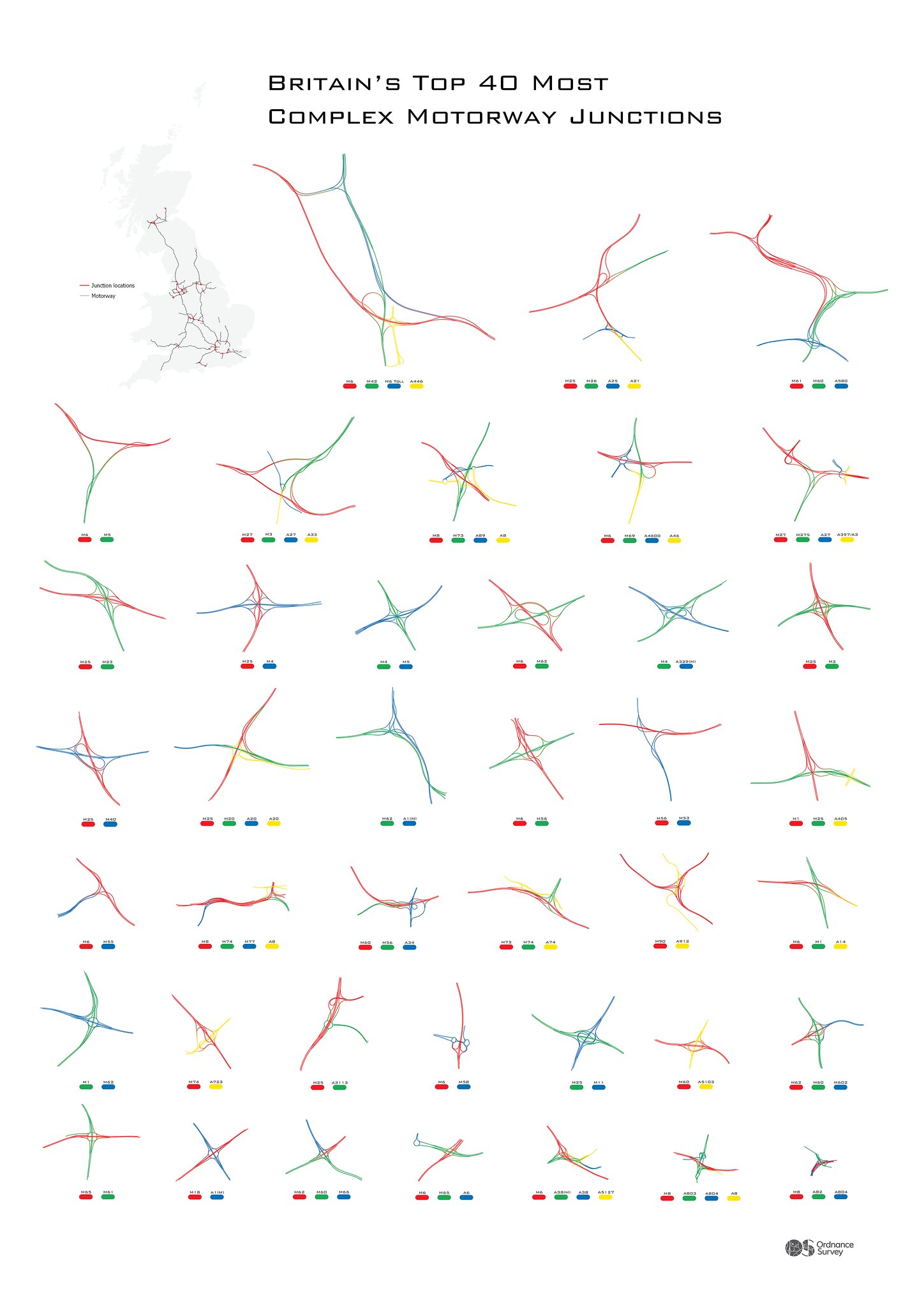
Ralphs’ opening sequence, the playfully titled ‘Common Prayers’, recalls Thomas Cranmer’s Book of Common Prayer, a founding text of Anglicanism. The plural ‘Prayers’ undoes Cranmer’s uniform singularity and points to a celebration of the individual voice. The first poem, ‘after George Herbert’, is similarly tricksy, and works with Herbert’s 1633 ‘The Call’. ‘Come, my Way, my Truth, my Life’, Herbert’s speaker prays, in a trinitarian list which evokes John’s Gospel’s ‘I am the way, the truth, and the life’ but here Herbert capitalizes ‘Way’, ‘Truth’ and ‘Life’, perhaps denoting them as aspects of God’s godliness. Ralphs opens her poem with ‘Come, my Motorway, my Equals Sign, my Higher Race, / such a Motorway as wheels with stars’. Where Herbert’s poem focuses tightly on God, measured in monosyllables, viewing complexity through the lens of simplicity, Ralphs’ poem achieves the opposite. Her ‘Motorway’, ‘Equals Sign’ and ‘Higher Race’ are jarring – and especially as her line is haunted by the simplicity and beauty of ‘Way, Truth’ and ‘Life’. Modern life feels and sounds rubbish. Her conceit is worthy of Donne. Perhaps we imagine the convergence of motorways, viewed from above – like the biological beauty of the M4’s junction with the M5, or laced together like the M6 and the M62, the pinpricks of headlights orbiting the junction’s axis like stars spinning around the Galactic Centre. The seventeenth century malaise was Galileo’s heliocentrism – it was the push that sent humanity spinning away from the warm lights of centre stage and into the shadows of the wings. Ralphs undoes this as the motorway ‘wheels with stars’. We each become a little sun, the solipsistic centres of our own universes in a sea of meaninglessness: ‘Come, my Bedside Light, my Takeaway, my Calloused Hand’ but, through the rubbish, ineffable communication still connects us. Gloriously old-school alternate rhymes chime harmoniously, and the poem closes with a resounding ‘yes’.
The next section, ‘Malkin’, revoices the people tried for witchcraft in Pendle at the Lancaster Assizes in 1612. As Ralphs notes, we’re left with the records of the court clerk, Thomas Potts, who would be aware of James I’s unsavoury interest in witchcraft. The documented voices of the victims have, more than likely, been tuned to the ear of the king. Even though these people are 400 years in the grave, Ralphs marks each one executed for witchcraft with a typographical obelisk: † and, in so doing, their demotic is elevated to the status of sacred – the murdered become martyred. ‘Anne Whittle †’ is punctuated by her stutter and speech impediment: ‘And after, well fed-up but famished, I knashed at th bare bakside / of an apl csh csh – – / nd an appl & / another apple – and felt non the better for it, only old.’ It’s touchingly human – and especially the real confession here – that she felt old. She ‘confessed’ to dining with a spirit, and perhaps this accounts for the ever lengthening of the poem’s lines – hardly a confession, but rather a tall story (think Monty Python’s ‘The Four Yorkshiremen’). A side effect of these long lines is the rotating of the poem 90° on the page – and this leads us back to George Herbert’s ‘Easter Wings’, itself perhaps an echo of ancient Greek technopaegnia – poems inscribed on objects like altar stones from which they took their shape. Like the obelisk by her name, even her poem becomes a memorial, lending Anne Whittle a new dignity.
The collection’s title, After you Were, I Am, reads like a prayer but perhaps it’s supposed to be taken literally and makes us mindful of the fragile links in our human chain. It’s exquisitely wrought and breathtakingly beautiful but, like George Herbert’s The Temple, there are no cheap sideshow stunts here. Form and function reanimate the dead and in their fragility and mortality we see ourselves.
RELATED LINKS
 Poor Rude Lines